






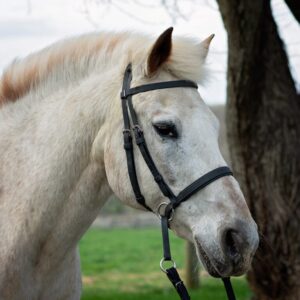
Teddy–AKA Mr. Terrffic
Much to my surprise, I am coming up on the end of my first semester as an aspiring therapeutic riding instructor. I am by no means done with my apprenticeship, but I wasn’t sure I’d make it this far. I’m pausing to reflect and take stock. What have I learned these past few months? Where were my expectations upended, what do I need to focus on going forward to be the best I can at this new undertaking?
My first revelation is that the required lesson plan can be a huge distraction from learning if I allow it to be–and I have. Example: I put together a spiffy little exercise about adjusting the horse’s pace within a gait. Can the rider ask for a faster walk without breaking into the trot? A slower trot without cuing the walk? Very important skill for tuning up communication between horse and rider, ensuring reins are the proper length, and giving the student tools for maintaining safe distances when riding in a group. How wonderfully functioaln this objective is. One might even say elegant, might one not?
 The lesson went along safely and the student seemed to enjoy the time in the saddle. The supervising instructor had to gently point out, though, that the student wanted to use the hour to do more independent riding, and thus the rider was without a horse leader for much of the lesson. The plain evidence right before my very eyes was… my rider was having trouble steering.
But there I was blathering away about exhaling to achieve a downward transition, and congratulating myself on keeping the lesson on track time-wise, while Mr. Very Smart Pony (Teddy) was blowing off his rider’s attempts to keep him from the middle of the arena (the universal rest stop location known to all school horses from time immemorial). Steering is kinda right up there with whoa and go in terms of basic abilities, and rather than focus on that gap in the student’s skill set, I remained determined to execute my brilliant lesson plan.
Note to self: Be more nimble Grace–adjust your pace within the teaching gaits--and pay attention to the student rather than to prioritizing the syllabus.
 The other lesson I’m taking away from round one (so far) is that joy is central to the learning experience. Compulsory education ignores this truth at its peril, but the extra curriculars know it well. Nobody has to learn to play the tuba. No nine year old is required by state law to schlep out to the horse barn in the pouring down rain to work on the posting trot. Both are difficult undertakings full of set backs, frustrations, and plateaus.
The first goal of all my lessons–after safety, safety, and safety–must be providing a positive experience at the barn. If you want to improve every single measure of success at a struggling school, introduce an instrumental music program. Even the students not involved in the program will have better attendance, better grades, and fewer disciplinary incidents. My theory behind that miracle is that music teachers (art teachers, drama teachers…) know  that joy must be on the syllabus, and the world has more tuba virtuosos (and high school graduates generally), and happier school cafeterias because of it.
So in addition to my spiffy, one might even say elegant, lesson plans, I will be bringing my sense of humor, my smiles, my corny jokes, and my love for all things equine to the barn. At Teddy’s suggestion, I also ordered some kazoos.
What teachers do you recall with the most respect and gratitude? What was their superpower?
PS: The audio version of Worth More Than Rubies is now available from the web store!
I had a great math teacher in high school.
Geometry and Algebra were challenging for me. My math teacher had 2 afternoons that he stayed late – extra help sessions. I realized that I wasn’t the only one struggling- but our teacher reminded up that we were learning, not struggling. He was calm and positive!
He also suggested that if we had a question-to ask it – and if we were unsure about an equation- ask!
His super power??
He loved teaching and he understood that not everyone learns the same way!
It’s been a very long time since I had teachers and I don’t really remember them much. Except that I had to take Calculus I and II in order to be admitted to the master’s program in computer science. Since I was an international relations/cross cultural studies/literature major in college (1960s-70s liberal education), I had never Calculus since I was able to avoid it in high school (loved algebra but the rest not so much). Anyway, the Calculus I teacher at the local community college treated us like high school students with assigned seats and having to do work at the blackboard to make sure we did our homework. It was awful since I was in my 30s at that time. But the Calculus II teacher treated us like the adults we were and I was much happier in his class. Did I learn more in one or the other? Who knows? I just remember how they made me feel.
I was fortunate enough to have the same science teacher for all 3 years in Junior High School (grades 7-9 in my community). She used a deductive reasoning method of teaching, giving us bare facts and trusting us to reach an appropriate conclusion. I remember her working so hard sometimes to get us to come to the right answer. But I have never forgotten some of the science she taught. When I got to High School, I had the absolute worst chemistry teacher. He just droned on and on and on, spewing out dry and boring information for an hour straight. I don’t remember anything at all that he attempted to teach us, and I imagine my classmates’ experience was similar. A great teacher, in any subject, is truly an under appreciated gem. I have no doubt, Grace, that you will be exceptional! Stay safe. Stay well everyone!
I still bless my 5th grade teacher for introducing us to…wait for it…fountain pens!! This was before they got stupidly expensive for basic cartridge fillers. Kids who couldn’t afford them were loaned from a class stash. We could use any color cartridges we wanted. Peacock Blue & Emerald Green were my jam, though I occasionally ventured into red or brown. Any nib whether F or M. Any pen barrel color (Blue).
In short, she got us so wrapped up in the artistic & mechanical fun of the things, we completely ignored our improving penmanship & the amount of writing we were doing! In fact, she would adopt a conspiratorial air & tell us, “Shh! Don’t tell the other teachers, but you can use ANY color ink you want to write! Just write!”
We burned through paper & cartridges at a rate of knots, no one complained about homework, & the amount of book reports, essays & epic responses to What I Did Last Summer & other weighty topics was truly amazing!
Learning that relaxed tripod grip & why pressing down on the page was tiring stood me in good stead all the way through grad school. And I use fountain pens to this day because they’re restful when I have pages to write, not type.
Mrs Breslin is long dead, but her class lives on in memory when many others have faded to a blur. It’s a gift to slide grammar, punctuation & spelling into children’s brains without their noticing.
I had a history teacher in high school whose superpower was remembering something quirky about every European ruler we covered that year. From 1066 and “Harold with an arrow through his eye” to buttons on jacket sleeves to keep the king or king to be from wiping his nose on his sleeve, we were able to remember who people were for at least that course and I am sure that there are still those who, like me, remember the stories if not the rulers. And of course that was when I learned “divorced, beheaded, died, divorced, beheaded, survived” for Henry VIII’s wives. That teacher was a gem.
And I know you will be a gem of a therapeutic riding instructor too, Grace! Those are very lucky kids who are teaching you how to teach…
Ah Grace, what a grand adventure you have begun. Therapeutic anything is amazing for the “teacher” as well as the “student.” I always recall my 2nd/3rd grade teacher (had her 2 years) who finally got me to read. She came up with all sorts of activities to keep me interested. I still recall one in particular. I wonder if that is where I learned to follow a child’s lead when trying to make gains (I was an OT & a PT). I would come into the session with an agenda to move toward a goal. I took what a child was interested in and turned it into a game or activity addressing the goal. I agree with the joy concept totally. You will be fabulous.
My education blessed me with many phenomenal teachers. I became adept at finding classmates as teachers as well, and wound up with an interesting college transcript following teachers who were passionate about their subjects, or their students or learning in general.
I also valued those as you learned who could swivel and bend with a class. I had one starchy German professor harangue us all on not wrecking our health in search of the almighty dollar, advanced degrees. Small class and one had dropped due to something. She didn’t say, other than to tell us life was too short to spend it broken.
An older Frenchman was passionate about wine. One of our quizzes was him holding up various wine glasses and bottles. We were to identify the glass or bottle, the wine served in it and an example of same. For some of us, the five gallon jugs of rough red from Morocco were all we were very familiar with, and our wine glasses sometimes empty jars. It was fascinating.
My favorite college professor was a funny, brilliant man with a courageous sense of adventure. A WWII veteran and paraplegic at age 18, Dr. Orr nevertheless had traveled extensively (he regaled us with stories of ascending mountain paths in Italy while tied to the back of a burro). During the 70s there were few ramps, curb-cuts, ground-level elevators etc. to facilitate wheelchair travel, and he suffered daily inconveniences and indignities. Yet he was a powerful presence in and out of the classroom. He lobbied fiercely and successfully to make the campus accessible to people with disabilities, well before such retrofitting was required. His Socratic teaching style generated lively, far-reaching discussions. He connected comments about the campus ginkgo trees, for example, to lessons about the Far East. He assigned short, targeted texts (Three Ways of Thought in Ancient China; Journey to the Beginning; Apes, Angels and Victorians) rather than using a single 5-lb obsolete textbook. To Grace’s point, he found ways to trigger our interest and curiosity and engaged us fully and joyfully.
PS. That was only 1 lecture on the French wine industry in a class on French Culture.