






 As an undergraduate at Penn State, I became involved with the campus newspaper, The Daily Collegian. Our newsroom was housed in the Carnegie Building, a venerable old relic from the early 1900s. I never gave much thought to the building’s name, figured it had something to do with Andrew Carnegie, who was a Rich Guy who lived Back When.
I did know that Carnegie Building had been the university’s first free-standing library building, and it seemed appropriate that the School of Communications should inherit Carnegie Building (the largest school of communications in the country, who knew?).
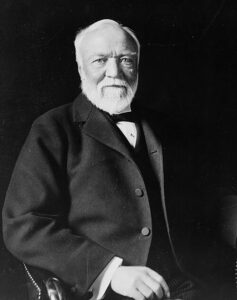 Fast forward a few decades and I’ve just finished a biography of Andrew Carnegie, who was, in his day… the richest man in the world, richer by far than the oligarchs we have underfoot these days. He was the son of a Scottish weaver put out of work by technical advances in loom design. The family emigrated to Pittsburgh in 1848, where they had friends and relatives already established in the United States.
Carnegie rose to great wealth through a combination of luck (tons and tons of luck), charm, genuine business smarts, and sheer ruthlessness. His schtick was making steel, and he happened into that business at a time when America was building infrastructure at a phenomenal rate. Railways, bridges, skyscrapers, military vessels… all required tons and tons of steel, and Carnegie cornered the market, largely because eastern European immigrants were willing to work under hideous conditions rather than starve. Then too, he benefited enormously from protectionist tariffs levied to keep the American steel industry from having to compete with established suppliers overseas.
The Sherman Anti-trust Act owes much to men like Carnegie who colluded endlessly to enrich themselves and one another at the expense of their employees and customers.
 But at the age of thirty-seven, Carnegie stepped away from active business. He turned over his companies to managers, he started looking for a buyer for what would become his U.S. Steel stock (John Pierpont Morgan took the bait many years later), and he began giving away enormous sums of money. He made it his public mission to give away staggering sums, funding all manner of public and academic libraries, technical schools, university posts, museums, and “Hero Funds,” to support the survivors of those who’d lost their lives trying to save others.
He also became an outspoken and tireless advocate for peace, using his social stature to presume on six different presidents more or less at will. He became an object of ridicule in old age, because men like Teddy Roosevelt regarded peace advocacy as so much impractical ranting from clueless dreamers. This did not stop Roosevelt from asking Carnegie for huge sums to fund a year long big game “research” hunt, and Carnegie came through.
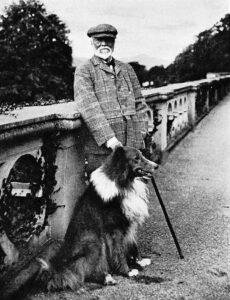 This book did not sit well with me, in part because Carnegie was so contradictory. Maybe fiction writing and reading–or the news trying to impersonate entertainment?– has conditioned me to look for characters who fit into simple functional roles–protagonist, sidekick, mentor, antagonist. But I was also struck by the fact that this one small man (5 foot 3) was worth much more than any of our present day oligarchs in constant dollars, and he chose to use his wealth to found more than 1700 libraries in North America alone. One of his charitable foundations was responsible for the grant that resulted in Sesame Street and the Children’s Television Workshop.
His influence is nigh incalculable, as both a philanthropist, and as an example of a capitalist who could justify taking lives (ten workers were killed when strikebreakers were brought in to the Homestead Mill) for the sake of… money?
 In any case, I found Carnegie’s tale important both for the good he did and the evil he perpetrated, but his story isn’t well known. If we included his Gospel of Wealth in our economics curricula (essentially, Rabbie Burns socialism under the guise of noblesse oblige), would we be where we are? Would we be in a worse place yet?
The book made me think and question some of my assumptions, and that’s a good thing. What important life stories have you come across that either inspired or troubled you?
PS: Look who finally got a cover!
I haven’t read Carnegie’s book but if it would help people with the means to help those without, I think it would be good to include it in the curricula. Unfortunately, I have believed for a while now that the country has regressed to the age of the robber barons who are only looking out for themselves. It saddens me so much. The worst, of course, is that this history is being erased and instead the idea that all those rich people got that way through hard work so you poor people should be able to do it, too, has been marketed so successfully. And, unfortunately, this fish is rotting from the head down.
As for significant life stories, I have read so much in my life that I think I have picked things up by osmosis since I don’t remember any in particular. But I do remember the lessons, so that’s something.
And I really like Lord Julian’s covers even if I don’t always recognize the objects and how they fit into the story.
The interesting thing is, Carnegie’s mega-rich cronies thought he was nuts, but then he sort of shamed them into philanthropy at the same time. They could not keep up with his generosity, and they were probably doing it not out of delayed Scottish populism (or guilt), but rather, to shine up capitalism’s reputation in hopes of staving off Progressive reform. Still, these guys gave away fortunes, and now would be a good time to remember that.
I like the cover, Grace! And I can’t wait to read more Lord Julian.
Some of us were talking about characters of the Old Testament. King David comes to mind as a talented human being who was not allowed to build the temple as he was a man of war and had shed blood. Human beings are complex, aren’t they? And that comes through even ancient retellings, rewritings and probably some cancel culture.
I am probably going to come across as shallow but my philanthropist hero is Paul Newman. He didn’t gain his wealth on the suffering or expense of others in the pattern of Carnegie et al. He was a mere mortal for sure. The quote that follows is my favorite.
“If people realized how much fun it is to give money away they wouldn’t wait until they are dead to do it.” – Paul Newman
I knew Carnegie was an amazing philanthropist, but did not know his entire backstory. What a combination of initial greed followed by later generosity. I applaud anyone who thinks libraries are institutions worth their beneficence. I cannot name specifics, but I have read, more than once, of very humble people who have worked their entire lives, living frugally, then leaving behind millions of dollars to their communities. Unknown, unsung. Those are real heroes, but my heart breaks to think they denied themselves so much in order to allow others to benefit.
I have been thinking about this kind of ‘noblesse oblige’ lately myself due to present political situations. It has frankly, been so disheartening that I swing between anger and a depressing sick stomach. Both of which leave me feeling useless. Both my husband and have decided it raises our blood pressure to discuss every evil thing that gets reported every day, but sometimes something utterly egregious happens that I cannot-not talk about it. Just a few days ago I was questioning (rhetorically) my husband who remembers his history reading unlike myself: Where are the incredibly rich men these days that are building hospitals and libraries and universities, etc., like (my words) ‘you know, those men who did that kind of thing generations ago?’ What is wrong with these people. I don’t know if these modern men were horrible to their employees, but they obviously have no Scottish guilt in their actions toward the common men and women who make up this country. No. They want to destroy PBS, choke off the services of libraries, cut funding for humanitarian purposes to other countries, the list is staggering.
The biographies I’ve read that usually both inspire and distress me tend to be those of women who were different than the women of their day, those who wanted and demanded education, contributed to the sciences (math, astronomy) and the arts. And so many of them were never given the credit they were due oft times in truly humiliating ways. Yes, we are talking about them today but their stories depress the ____ out of me. I so deeply admire and empathize with them. I prefer fiction. I’m too old to do anything to change society. We give to as many humanitarian charities as we can, and that usually makes me sad I can’t do more.
I’m so pleased to see the new Lord Julian book launched. I’m behind, but I love those stories so much that I feel calm knowing that there are more waiting for me yet. I’m laughing at myself but it’s really true it really is satisfying. All the best luck on ‘Questionable Judgement.’ I suspect you will sit on your laurels for just a little while. You are a working woman, and your work brings such joy to so many people. We all love you Grace.
The cover looks awesome!
I am not really attracted to biographies. Possibly it is because, when I read about a person’s life, I have the feeling that the author is giving me an image that is the one he wants me to believe about that person, but it is not complete. And I ask myself: what is it that he is not telling me? What aspect of this person’s life is he not telling me about? What is the missing piece…?
People are complicated, aren’t they? A tiny Carnegie library exists in rural Georgia, about 25 miles from my residence. Every time I pass it, I am reminded that I need to mind the “nuances” in the character of my fellow humans.
Do we know what precipitated Carnegie’s moral turnaround? That would be an interesting story for sure!
It’s funny, I had a conversation with my husband yesterday on the politics or motivation of the likes of Warren Buffett and Bill Gates and their capitalism and philanthropy. Carnegie’s road to philanthropy is not a spotless one, but as a user of the library (built 1913, grant of £8,500) in my small town in Dublin, Ireland, when I didn’t have the space or books at home, I’ll be forever grateful.