





Have you visited Grace's Bookstore?

The Besotted Baron
Book 4 in the Bad Heir Day Tales series
The last thing Camden Huxley wants is to sort out his family’s sprawling Yorkshire estate, along with its squabbling tenants, retainers, and neighbors. Cam nonetheless turns his back on his greatest passion–trade–and travels to Lorne Hall, telling himself all the while that he’s merely making the duty visit required of any new titleholder.
Matters at the Hall are in serious disarray, but what alarms Cam even more are the matchmaking ambitions aimed in his direction. Miss Alice Singleton, granddaughter of the antediluvian estate steward, is a voice of reason and common sense, and she’s also sweet, kind, and possessed of a wicked sense of humor. To Cam’s bafflement, Alice alone seems to have no interest in becoming his baroness. For her part, Alice is indeed smitten with the new baron, but she has learned to avoid entanglements of any kind, and she is determined to make no exceptions even if this time, she really has fallen in love.
Cam and Alice will have to overcome old secrets and new betrayals, and learn to trust their hearts and each other if they are to have any chance of a shared and joyous future.

The Besotted Baron:
Enjoy An Excerpt








Chapter One
In the opinion of Camden Huxley, twenty-eighth Baron Lorne, attending the burial had been safe. Women did not usually participate in graveside services, and to his unseemly relief, no women had been present.
But Leopold St. Didier had attended the burial as well, and Cam had thus been put on notice. Some delay would be tolerated, but outright shirking of inherited responsibilities wasn’t an option.
Cam had never in his entire sojourn on earth shirked, despite all temptation to the contrary.
“You’ve waited three months,” St. Didier said, pouring two exactly equal servings of cognac. “If you don’t see to the place now, soon it will be three years.” Camden’s host held out a drink, the firelight giving mere potation flaming depths. “To your health, and to the prosperity of Lorne Hall.”
“The two haven’t been related for some time.” Camden nosed his drink. Apples, a whiff of damask roses, a hint of nutmeg all trailing into citrus and cinnamon.
How did St. Didier afford such an indulgence and where did he procure it?
Camden drank sparingly. One wanted his wits about him in any encounter with St. Didier. To look at, the fellow was unremarkable. Tallish, dark-haired, neat about his habiliments, soft-spoken. Wore his hair long in the old-fashioned style and wore his family’s downfall with an understated indifference Camden envied.
“Your reputation and the health of the barony are related now.” St. Didier settled into the opposite wingchair, both seats designed for sizeable, sturdy occupants. “Will you sell the business?”
No, he would not. “That seems to be the general assumption.” The business Camden had spent twelve years building up from nothing. The business that was thriving more handily than ever now that the Continent was once again open to English trade. The business that had gambled on establishing itself in the former colonies and with notable success.
The business that could in no wise be excused as a mere investment. Camden was in trade, and there he intended to remain.
“When have you ever behaved in accordance with general assumptions?” St. Didier sipped with a sybarite’s focus. “I’ll accompany you to Yorkshire, if you like.”
St. Didier was regarded as shrewd, intelligent, frighteningly well connected, and honorable. He was not known to be notably altruistic. The conscience of reluctant peers, the silent minion of the College of Arms, and unnervingly self-contained.
Cam respected him as one respected the patronesses at Almack’s. They wielded immense power without any real legal authority, and yet, to cross them was to court ruin. Even a lowly tradesman understood that much.
“Why would you escort me to the Hall? I know my way there well enough if I choose to go.”
“Firstly, because you are overdue for a repairing lease and cannot be depended upon to take one. You look closer to forty than thirty, you’re a good stone underweight, if not two. You aren’t getting enough sleep and haven’t for some time. I would attribute the insomnia to grief, except that it pre-dates the late baron’s passing by years.”
“I sleep quite well.” Camdem did not sleep enough, though. Drifting off into an exhausted slumber while poring over the ledgers was a nightly ritual.
“You work to the point of daily collapse, a very different proposition. My second reason for offering to accompany you to the family seat is that your cousin Bernard has asked me to see that you look in on your inheritance.”

“Bernard the busybody.” All in the name of Christian concern, of course.
“He and his mother are worried about you.”
“They are worried about his living at St. Wilfrid’s, which is secure. I can write him to that effect.” Another sip of heaven. Mention of sleep was having a soporific effect, so Camden sat up and set the cognac aside. “I’ll pay a call at Lorne Hall later in the year.”
“Later in the year, you will conjure up some superficially compelling excuse,” St. Didier said gently. “This being high summer, you are shipping goods in quantity all over creation before the autumn storms start. As autumn progresses, you will be planning for next year’s markets, dunning those who are slow to pay, and looking for new merchandise to add to your inventory. In winter, travel is difficult. In spring, the ships go out again.”
A perfect sketch of the commercial year, but without mention of the risks, rewards, and excitement that came with every single day piloting the enterprise.
“Lorne Hall can manage harvest quite well without me,” Camden said. “They’ve been doing so for generations.” I would just be in the way. Indisputably true, also close to whining.
“They’ve not had to manage harvest without any lord of the manor at all. Besides, your family seat is one of the most beautiful estates in all of Yorkshire. I’m in need of a respite myself, and Lorne Hall suits my plans.”
“Then go and enjoy yourself with my blessing.” The Hall was breathtaking, and its appeal as autumn approached was unparalleled. Golden sun, peaceful bucolic vistas, sheep and cattle fat on summer grazing. The Hall itself glowing with contented splendor. “The twentieth baron designed the place, set it up so it aligns perfectly with the equinoxes. I was named for him.”
St. Didier’s eyes took on a gleam that in another man might have presaged a smile. He said nothing, merely sipped his drink and considered the fire crackling in the hearth.
Why not go? Why not get it over with? Let them all gawk at the prodigal returned. Let Bernard pontificate a bit and Aunt Josephine advise and admonish. Look in on the tenants as Papa used to, greet the neighbors in the church yard. Do the expected, just once, and be done with it.
By now, Alice was doubtless the contented mother of four, her husband a doting pillar of rectitude. The children would be precisely spaced two and a half years apart, and each child would be more perfectly well behaved than the last.
“You should make the journey for another reason,” St. Didier said, peering into his drink. “Now is the logical time to retire the old guard, promote from within the ranks, or bring in new faces. Your brother’s will made provisions for a few pensions and minor bequests, but the likes of Mrs. Shorer, Beaglemore, and Singleton won’t step down until they have your blessing to do so.”
“Mrs. Shorer won’t step down unless God almighty gives her leave, and then she’ll take her own good time doing it. I can send Beaglemore a glowing letter commending his decades of service, and Singleton is hardly of an age to retire.”
Housekeeper, butler, and land steward. They were the triumvirate that presided over the Hall’s workings, and they each excelled at the job assigned.
“Surely Mrs. Shorer has a replacement in mind?” Camden went on. “An under-housekeeper trained up for the past twenty years in the ways of cleanliness and domestic industry?”
Mrs. Shorer had been a force of nature in Cam’s youth. Never still unless addressing her employer, and then only for as long as necessary to report or receive orders. She hated dust and sloth, but had a soft heart when it came to restless little boys and moody adolescents.
“Mrs. Shorer’s preferred understudy ran off with the first footman last year. Both parties claimed that waiting for the end times to earn a promotion was beyond them. They are employed in the same household down in Shropshire, last I heard. Secretly married, if my sources are to be believed.”
“How do you know these things?”
“I correspond with my acquaintances. You should try it sometime. One learns the oddest, most useful things simply by putting pen to paper.”
“And then one is condemned to spend the livelong day burdening the king’s mail with platitudes and gossip, because one’s letters result in replies, and the replies must result in same, until half the realm is wasting its days in correspondence.”
St. Didier rose, tossed a square of peat on the fire, and resumed his seat. “There speaks a man short of sleep.”
Oh, probably. “Tell me how Beaglemore is getting on.”
“Slowly. Poor old thing has the rheumatism. Not so bad in the warmer weather, but cold, rainy days try him sorely.”
Merry Olde had a surfeit of those in any season. Beaglemore had been an institution for as long as Camden could remember. Almost as a complement to Mrs. Shorer’s incessant bustling, Beaglemore never moved faster than a dignified strut, like a rooster patrolling his yard. The old fellow ruled over the footmen and porters with an iron hand, but had a dry sense of humor too.
“Has Beagle suggested which puppy ought to replace him?”
“Lately, he’s had his nephew in mind for that honor, but the man was offered a post as under-butler in a ducal household. In all good conscience, Beaglemore had to support the change of employment.”
Our title is older. The familiar retort, heard since infancy, served no purpose. British dukedoms had first been created by Edward III in the 1300s while the oldest British royal baronies—Lorne among them—dated from the 1200s.
“Well, surely Singleton will be tending to the land for some time to come.”
“Singleton has seen his seventy-fifth year,” St. Didier replied, “and his granddaughter claims he’s losing both sight and hearing. A steward must be out in all weather, all year long. The job is better suited to a younger man.”
Singleton could not be five-and-seventy. Not possibly. The image of a tall, fit, white-haired man came to mind. Cravat always spotless and neatly tied, despite mud and worse on his boots. Sat his horse with more dignity than Wellington on the eve of battle and had a way with animals that defied science.
To think of Singleton’s powers withering… Dover’s cliffs should fall into sea first.
Camden tried for a casual sip of his brandy. “Miss Singleton is still in the area?”
“She is.”
Damn St. Didier’s reticence. “I don’t suppose her husband could take over as steward?”
“She hasn’t one of those, that I know of.”
Why on God’s green and gorgeous earth would Alice Singleton remain unmarried? Had Yorkshire’s bachelors lost their wits? She was smart, confident, robust, and she also…
Cam’s business instincts tapped him in the figurative shoulder. Alice also had no dowry. Her grandfather was in his dotage and leave her little save a collection of pipes, and she, while kind, had little patience with fools.
Camden had always respected that about Alice. Nobody could deliver a tongue-lashing quite as effectively Alice when she was truly inspired.
“Stewards are two a penny these days,” Camden said. “Singleton will have left the estate in good trim, and I’m sure he’ll be on hand long enough to acquaint a successor with the basics.”
St. Didier finished his drink and took his empty glass to the sideboard. “An estate is not like a shipping business, my lord. In your counting house, you can hire and sack clerks by the week, and the new fellow will add up his sums as competently as the tippler he replaced. A steward, butler, or housekeeper is more like… you. They sit at the helm of an enterprise that produces measurable results. Prosperous acreage or a comfortable abode for family, guests, and staff. If you treat replacing these senior retainers casually, the whole estate will suffer for it.”
Alice could also be quiet with her scolds, as St. Didier had been. Her silences could condemn a thoughtless fellow to purgatories of guilt, and her smiles…
“I cannot leave my business, St. Didier. It does not run itself, and while I have good managers, they are managers only. If a ship is two weeks late, then the decisions to be made belong to me alone. If one of the managers expires of food poisoning, I am must step in and take over his responsibilities.”
“One of your managers died of food poisoning?”
“Another ran afoul of a rusty nail. Another came down with a serious case of religious zeal and decided he must impose the gospel on the otherwise perfectly contented denizens of some far-flung wilderness. I was sorry to lose him. He was honest to a fault and always smiling.”
Camden stopped himself from recounting other dramas, of which there were many. Affairs of the heart, embezzling, rivals attempting to plant spies, spying on rivals… The simple business of exporting scientific instruments and books made Drury Lane look staid by comparison.
“Then,” St. Didier countered, “you understand what your people at Lorne Hall are facing. Their managers are all mustering out and they have no lord of the manor to keep order in the ranks while the guard changes. They will be grateful to see you, and take direction from you willingly. Leave them to flounder and bicker and argue for another three months, and you will not receive half so genial a welcome.”
“You should have been a barrister.”
“You are a baron, whether you like it or not.”
The St. Didier title had fallen into escheat—no legitimate male heir, assets reverted to the crown—and thus St. Didier’s observation landed like the reproach it was meant to be.
“I am in trade.” I am in trouble would have been the more accurate admission. “I have no use for Lorne Hall or its acreage.” Other than to sell it. “And the Hall isn’t the family seat, technically speaking. Lorne Hall was originally a dower property, though the dower house was built on a far grander scale than the original baronial abode. Wealthy brides will insist on these measures. The historical family seat is Loarnoch, a small manor ten miles north of the Hall.”
St. Didier’s brows drew down. “I was not aware of this.”
Camden glanced out the window to the twilight that passed for a late summer evening in London. “The sky remains in its assigned location, nonetheless. Loarnoch is pleasant enough, but it’s just a manor and a couple thousand acres mostly fit for sheep. It’s also still entailed. The twentieth baron and his son broke the entail on the Hall and few other properties, some of which have been sold.”
A spare was brought up to know this arcana, but not to have a use for it.
“What has been done with the older property?” St. Didier asked. “Rented out? I don’t recall the solicitors mentioning it.”
“When did you have occasion to speak with my late brother’s pet weasels?” Cam had dealt with them by correspondence. Always better to have a written record when lawyers were involved. More of the wisdom of the shop.
“You really do need to have a look at your inheritance,” St. Didier replied, which was, for him, an awkward prevarication. “Your brother might well have sold this other place and one wants to know where the proceeds went.”
“He could not sell Loarnoch. The entail hasn’t been broken. My consent would have been necessary and I was never asked for it.”
St. Didier scowled at the fire. “Signatures can be forged, meaning no disrespect to the late baron.”
Who had been unwell for some time prior to his death.
You should go. Something is amiss. You have the authority to put it right. The voice belonged to Alice. Practical, forthright, unmarried Alice. Why hadn’t she married?
Cam finished his drink. “I’ll need a week’s preparation at least, and I can’t be gone for more than a fortnight. You are welcome to join me.” Welcome being a slight overstatement. One wanted St. Didier where one could keep an eye on him.
“You shall have three days to prepare for the journey, and considering that Yorkshire is nigh 200 miles distant, you should plan to be gone a month.”
“Three weeks, including travel.”
“We leave in three days. When you return—if you return—is up to you. Send your pigeons with the baggage coach, and be prepared to move fast.”
Cam rose and bid St. Didier a cordial goodnight, though he had the sense he’d just struck a bad bargain with familial duty. In Cam’s experience, family duty was unparalleled at creating drama and misery, the only greater sources of same being Atlantic hurricanes and—in the young and callow—unrequited love.
End of Excerpt
The Besotted Baron is available in the following formats:
Grace Burrowes Publishing
October 24, 2025
- Grace’s BookstoreThis is Grace’s
independent
ebook store.
Your purchase can be added to any device. - Barnes & Noble Nook
- Kobo
- Apple Books
- Amazon Kindle
eBook:
Other eBook Purchase Options:
- Waterstones
- Kobo UK
- Amazon UK
- Amazon Kindle UK
United Kingdom:

Connected Books
The Besotted Baron is Book 4 in the Bad Heir Day Tales series. The full series reading order is as follows:
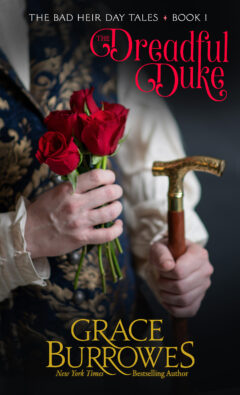
- Book 1: The Dreadful Duke
- Book 2: The Mysterious Marquess
- Book 3: The Elusive Earl
- Book 4: The Besotted Baron
- Book 5: An Heir of Distinction
- Book 6: An Heir of Possibilities