




Have you visited Grace's Bookstore?

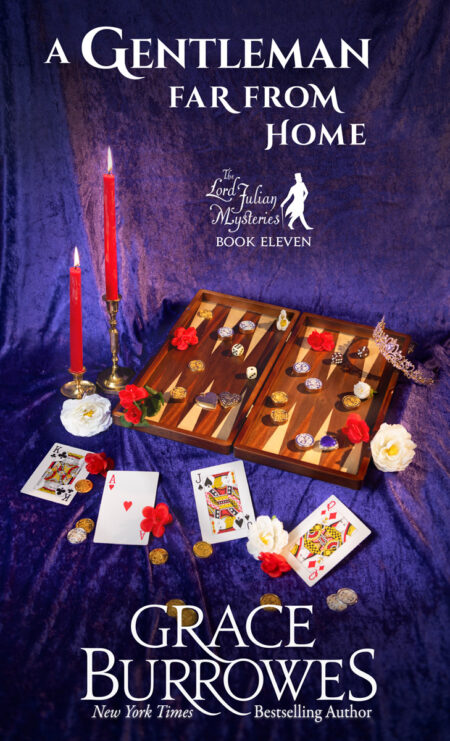
A Gentleman Far From Home
Book 11 in the Lord Julian Mysteries series
When one of Wellington’s best sharpshooters is threatened with dire consequences if he returns to his family seat, Lord Julian Caldicott is called in to unmask the blackmailer. Julian is willing to take on the investigation for the sake of a former soldier’s wellbeing, and also to relieve the grinding monotony of deepest mid-winter endured alone in rural Surrey.
Amid the sprawling elegance of Dunsford Keep, Julian finds a family on the outs with each other, their neighbors, and their own past. Lies and suspicions fly in all directions as accusations mount and Julian’s own family is pulled into the affray. If Julian cannot target the guilty party, an innocent man will be exiled from his home forever, and Julian might well be banished from Caldicott Hall too!

A Gentleman Far From Home:
Enjoy An Excerpt









Chapter One
Bryson Carstairs had lost weight since I’d last seen him, and he’d been lean to begin with. I rose from behind the library desk and extended a hand.
“Carstairs, good-day.” Why are you bothering me? Carstairs was a fellow former solider and a decent fellow, and thus I spared him that discourtesy. “Tea or brandy?”
“Lord Julian.” He shook hands—firm grip, nothing to prove—and also offered me a bow. His papa was a baron; my brother was a duke, and Carstairs was a polite fellow. “Anything hot would suit. My years in Spain have made English winters an endless purgatory.”
Spain, being mountainous in the extreme, had more than its share of cold, but I knew what he meant. Both the heat and the cold in much of Spain were arid. English cold was somehow more penetrating, though the chill of the French Pyrenees would haunt me until my demise.
Gloomy thoughts on a gloomy winter day. I should be used to them.
“Have a seat,” I said, gesturing to two wing chairs angled to catch the heat from one of the library’s enormous hearths. “You will stay for supper and spend the night, I trust? Darkness falls early, and your employer would take it amiss if his gamekeeper came to grief in a snow drift.”
That a former captain in the 95th Rifles should end up as a gamekeeper made a sort of sense. Gamekeepers were commonly among those few licensed to hunt with guns, and the Rifles, unique among the British military, had fought tactically rather than in formed squares. They’d made each bullet count instead of firing a volley intended to wreak havoc by sheer massed firepower.
Carstairs would thus know something about reading signs, assessing terrain, and living off the land. He might not be up to the weight of one of Wellington’s intelligence officers in those regards—my previous billet—but he was astute and observant.
Which begged the question once again: What possible problem could inspire him to bother me?
I tugged the bellpull before taking the second wingchair. A footman appeared less than thirty seconds later.
“Toddies, if you please, Finch, and some cheese tarts. Promise Mrs. Gwinnett will we not spoil our suppers. Let the housekeeper know that Captain Carstairs will join me for an informal meal. He will also be staying the night. Family wing quarters. The nursery should be warned that I will introduce a guest at sunset rounds.”
“Very good, my lord.” Finch fairly bounced from the room, doubtless cheered by the notion that a batch of toddies far larger than two men could consume was about to grace the kitchen.
“I did not know you had children,” Carstairs remarked.
“I have not been so blessed.” And probably never would be, a sore point, for several reasons. “My brother Harry’s son was given into our keeping by his mama, and we have the honor of raising him here at Caldicott Hall. He’s eightish going on forty-three some days. Going on three other days. Leander is a bright boy, but in a difficult situation.”
Illegitimate, in other words, with no siblings, and an uncle-come-lately left to oversee the boy’s education. Leander had been abandoned by his mama, who’d decamped to re-establish herself respectably in the shire of her birth. My older brother Arthur, Duke of Waltham, had settled a sum upon her sufficient to ensure that she would enjoy security for all the rest of her days.
What mattered that sort of security to a small boy who lived for his mother’s increasingly infrequent letters?
“I like children,” Carstairs said. “They are honest, most of the time, and not given to intentional cruelty until we teach it to them. How is Miss West?”

Hyperia West, my dearest love and affianced bride, dwelled in Town of late. Like my nephew Leander, I was preoccupied with the contents of the daily post, and frequently disappointed in what I found.
“Miss West is in great good health and enjoying London as the holidays approach.” I was to spend Christmas alone, in other words. His Grace was gallivanting around the south France, where I hoped never to set foot again. Arthur traveled in the company of his boon companion, Osgood Banter, in whose eyes the sun rose and set as far as Arthur was concerned.
They invited me to join them in nearly every letter, but a sensible person did intrude on what amounted to a happy couple’s wedding journey.
“And your aunt, Lady Ophelia?”
“Her ladyship is my godmother, but she too is apparently happily enjoying the London whirl. Before you ask, Her Grace took a notion to spend the holidays with an old friend in Hampshire, and will not return until the new year.”
I was alone in an enormous house full of staff in a shire teeming with familiar neighbors and tenants who’d known me since I’d worn short coats. The holidays loomed as sort of self-imposed test in that regard.
Immediately after Waterloo, I had returned to Caldicott Hall and found my ancestral home unbearably noisy, crowded, and dear. I’d endured the homecoming as long as I could, then holed up in my London townhouse and set about being an eccentric recluse. My cause was aided by the fact that my hair, once an unremarkable auburn, had turned white, and my nerves had shattered entirely.
A stint imprisoned by the French had left me a wreck. My reputation among my former comrades in arms had fared no better than my nerves. My hair had since regained some color, though I now resembled an exotic badger—darker hair at my crown, progressively paler locks down the length. I was developing a predictable case of winter mulligrubs to complement my appearance.
Carstairs likely knew something of my past, but I knew little about his.
“I am imposing,” he said. “I do apologize, but…” He looked around the library, his expression wistful. “You have so many books.”
A dithering former sharpshooter was a sad spectacle. “Feel free to borrow any volume that catches your fancy. The poetry is shelved in the far corner.”
Carstairs dabbled in verse, according to my sources, and was good at it.
“I hate winter,” he said, rising abruptly. “Hate it.” He ambled to the poetry corner, a loose-limbed, tallish fellow with dark hair in need of a trim. He’d been more neatly groomed when I’d seen him several months past, but his brown eyes had conveyed an abiding sadness even then.
“Your brother died in winter?” I asked, remaining in the wingchair. If Carstairs needed room to roam, the library could accommodate that urge. Caldicott Hall was a ducal residence, and the library a public room. Carstairs’s little cottage would likely fit in this one chamber twice over.
“Of course. Just after the holidays. I did not learn of his passing until early spring, but still… darkness and cold are bad enough. Illness adds insult to injury.”
Grief did that. No season was free of illness.
It occurred to me with a sort of dread that I shared with Carstairs the loss of a brother, and perhaps that sad commonality was what had inspired him to seek my company. Carstairs blamed himself for his younger brother’s passing, and I was at least partly responsible for Harry’s demise.
Wholly responsible in the eyes of some, who felt free to judge me without benefit of all the facts. I myself hadn’t all the facts, come to that. War, to say nothing of the abuses common to imprisonment, made for imperfect recollections.
“You have both French and German verse here,” Carstairs said. “Do you know how hard it is to write poetry in German that is poetry, and not merely coincidental rhymes? All that -heit, -keit, -teil, -veil inflection puts the art at a good distance from the craft.”
As the second son of a baron, Carstairs had enjoyed a solid education. Nobody, apparently, had instructed him on the fine art of broaching a difficult topic. In my experience, much of what we English referred to as manners was devoted to avoiding the near occasion of any such exercise. Turn us loose on a battlefield, though, and manners be damned.
The toddies arrived. I partook for the sake of my disappearing patience. “Carstairs, the drink will cool to unpalatability if you insist on continuing your evasive maneuvers. Then too, the man who disdains Mrs. Gwinnett’s cheese tarts is a fool.”
Though when I was in the grip of melancholy, I had nearly disdained to draw breath, much less eat. Carstairs did not strike me as that far gone, but he was in sorry condition.
He sat. He sipped. He stared at the fire, and when I held up the plate of tarts, he took two.
“Suppose you know I’m here to ask for assistance,” he said, considering his tart.
“Why, no. I assumed you missed my boundless charm and clever wit. Perhaps my gift for elegant bon mots drew you to the Hall? No? I confess, that only leaves my ability to untangle the occasional delicate puzzle that polite society tries desperately to ignore until the unsolved puzzle promises to ruin them.”
“I do not face ruin,” Carstairs said. “I am in exile.” He popped the tart into his mouth and chewed, though I doubt he tasted Mrs. Gwinnett’s exquisitely light pastry and delicately spiced cheese.
“Exile is a bitter fate.”
He sent me a puzzled glance. “You speak from experience?”
“I am exiled from many drawing rooms and ballrooms. Joining the lowliest of former officer’s clubs in London was denied me for a time. Wellington put in a few words on my behalf, and the grumbling grew quieter, but I am still not good ton.”
Hyperia claimed that my dubious status was of no moment, which assurances, I took leave to doubt. Darling Perry was an exponent of respected gentry and had a brother who had yet to embark on the great matrimonial adventure. Social ostracism would never be a detail to her any more than it was to my mother.
Carstairs took another abstemious sip of his toddy, and I realized when he’d asked for a hot drink, he’d been anticipating tea, cocoa, or coffee rather than anything stronger. Did he not trust himself to consume strong spirits?
“I am exiled and banished,” he said, setting the glass down. “Caldicott, I have been banished from the family seat, and I don’t know why or by whom or if my sentence will ever be commuted. I want…”
He stared hard at the fire. “I want to go home. Caldicott, I am weary and sad and exhausted. I am sick of wandering the woods and fens, of staring at pages of verse until I fall into sleep that does not refresh. Of killing game that seeks only to grow old in a peaceful procession of seasons. All I want, all I long for, is to go home.”
His voice broke on the last word, which doubtless mortified him as much as it did me.
I too found it necessary to minutely inspect the dancing flames. “I need details, Carstairs. You can hold nothing back, not for the sake of boyhood confidences, not for family honor, not for God and country. You tell me all you know, and I do mean all, or resign yourself to the life of an outcast.”
I half-hoped this condition would deter him from involving me. I half-hoped he’d accept the challenge. I’d known the horror of being imprisoned in cold and darkness by an enemy I’d seen and wished dead. Carstairs was incarcerated just as miserably, apparently by a foe who refused to come into the light.
An injustice of that magnitude was intolerable to me. I was prepared to take on the fight rather than endure more weeks of tipsy servants at the Hall and short notes from my dear Perry. I had to know first, though, that Carstairs would give me every possible weapon with which to wade into the affray.
And foremost among those weapons was truth itself.
He lifted his glass, examined the contents, set it down untasted, then fished a folded piece of paper from an inside pocket.
“This is the latest epistle. I never know when they are coming or who writes them.”
I unfolded the note: You may have five days after the new year. Five days and not one jot or tittle more. I know what you did.
The hand was a perfect, flowing script such as professional clerks and well educated young ladies prided themselves on. The paper was foolscap—cheap, plentiful, unremarkable. Conventional spelling, though the language was bit high flown. I knew jot to be the anglicized version of the Greek term iota, and tittle in English usually referred to the dot over a minuscule i, or perhaps an apostrophe indicating missing letters. A tiny mark that barely impacted meaning.
Headmistresses and tutors scolded in such terms, though Carstairs was not merely being scolded, he was being threatened.
“I know what you did. So what did you do, Carstairs? And please recall that most of my former fellow officers believe I bought my freedom from the French by betraying my brother and my command. Having been tried and convicted myself on the basis of gossip, I have no enthusiasm for judging anybody’s conduct, in uniform or otherwise.”
To his credit, Carstairs did not pry. Though I could have given him few answers if he had. I honestly did not know what had happened to Harry after our French captors separated us. I assumed that the same measures the French interrogators had applied to me had proven lethal in Harry’s case. He’d been fit and battle ready, but not to the degree that a reconnaissance officer must be.
Then too, Harry had had a temper that could blaze up without warning. A nasty, foolish temper that had landed him trouble more than once.
Perhaps Carstairs had a similar failing.
“What did I do?” Carstairs mused. “I shot where I was told to aim, of course. We all did, or claimed we did. On many occasions, I and my fellow Rifles missed the rider and felled the horse instead, but that’s simply because a horse is a much larger target.”
Infantrymen in their thousands had been guilty of the same purposeful inaccuracy. “You have been kept from your family home for more than two years, and you haven’t any idea why?”
He took a bite of his second cheese tart. “No clue. I have taken many lives, my lord. I have gone foraging and failed to mention that I met a French soldier doing likewise. I have committed the usual wrongs soldiers commit, though not in any notable excess.”
“Rape?”
He shook his head. “The Rifles were not generally involved in the worst parts of siege breaking, thank the immortal powers.”
“Plunder?”
“Wellington hung thieves. I’d no wish to hang.”
What did that leave? “Did you ever shoot the man when ordered to drop the horse?”
“Not that I can think of, and my lord, I have wracked my brains, pondered, re-read old letters, consulted with former comrades. One usually recalls all too vividly wrongs one has committed, but my memory yields nothing worth this sort of penance.”
I swirled my toddy and considered the man in the opposite chair. He was haunted, but by what or whom? The past, the banishment, guilt over his younger brother’s passing?
“You’ve been looking in the wrong place,” I said slowly. “Whoever is threatening you knows that you long to go home, to rejoin your family at your place of birth, and they know that allowing you only a few days of that dream will torment you afresh.”
“You are saying I did not commit a wartime offense? What is worse than snuffing out the life of some fellow who never did me an ill turn?”
Betraying your own brother? Betraying your command? “Let us save for another time the philosophies justifying national defense, and focus on your dilemma. You can think of no bad act, no lapse in judgment, no university prank, no drunken foolishness that resulted in harm to another?”
For the first time, I saw something like temper in his expression. “I am human. I make mistakes. I kissed women I probably should not have and got slapped for my presumption. I borrowed from my brother’s coin collection to buy sweets for one of those girls and spent some precious old penny in the process. I still regret that, and… I cannot think of any act or omission of sufficient seriousness to inspire anybody’s hatred.”
For a time, I had been an object of hatred. If a patrol had been ambushed on the slopes of the Pyrenees, then Lord Julian Caldicott must have given the French the details necessary to effect the slaughter. If rations intended for a particular regiment had been plundered by thieves, then Lord Julian Caldicott took coin for colluding with the bandits.
Wellington’s quiet defense of my character had scotched many of the rumors, but soldiers fared better when they had enemies to despise and destroy. And as surely as winter cold could kill, Carstairs had made at least one very determined enemy.
“We’re off to Hampshire after the new year,” I said. “We’ve some work to do before then. You will make the journey with me, and before we climb out of His Grace’s traveling coach, I will know your past more thoroughly than you know it yourself.”
I’d know his family, his friends, and—if luck was with us—his foes as well.
End of Excerpt
A Gentleman Far From Home is available in the following formats:
Grace Burrowes Publishing
January 23, 2026
- Grace’s BookstoreThis is Grace’s
independent
ebook store.
Your purchase can be added to any device. - Barnes & Noble Nook
- Kobo
- Apple Books
- Amazon Kindle
eBook:
Other eBook Purchase Options:
Print:
- Kobo UK
- Amazon UK
- Amazon Kindle UK
United Kingdom:

Connected Books
A Gentleman Far From Home is Book 11 in the Lord Julian Mysteries series. The full series reading order is as follows:
- Book 1: A Gentleman Fallen on Hard Times
- Book 2: A Gentleman of Dubious Reputation
- Book 3: A Gentleman in Challenging Circumstances
- Book 4: A Gentleman in Pursuit of Truth
- Book 5: A Gentleman in Search of a Wife
- Book 6: A Gentleman of Unreliable Honor
- Book 7: A Gentleman Under the Mistletoe
- Book 8: A Gentleman of Sinister Schemes
- Book 9: A Gentleman of Questionable Judgment
- Book 10: A Gentleman in Possession of Secrets
- Book 11: A Gentleman Far From Home
- Book 12: A Gentleman of Modest Ambitions