



 I noted elsewhere in this space that I went on weight loss drugs mostly because I wanted to give eighty-year-old me the best shot at life and good health possible. Another decade of obesity was counter that agenda. Eighty-year-old me sometimes chimes in on my financial decisions, too. She will often tell me, “I am glad you put that money in an interest bearing account, kiddo. Inflation is a thing, and I will still need some good chocolate on my grocery list!” She also reminds me, “You can’t take it with you, and that is a worthy cause. Pony up and be grateful you can help.” The old girl speaks her mind.
Six-year-old me has different wisdom to offer. I was still wetting my bed at that age, much to my horror, but six-year-old me soldiered on any way, and learned to run a load of wash in the middle of the night. She knows what it’s like when the body just Does Things–gets morning sick for eight straight months, has migraines, loses hair, gets wrinkly–and she tells me that it’s just part of being human, and not the sum of me as a person. Cope as best you can, and keep  moving forward. What a comforting view of matters.
Sixteen-year-old me goes more in the bad example column. She made stupid romantic choices, and stuck by them with ferocious stubbornness. Not to be outdone, twenty-eight-year-old me made even dumber wrong turns. I feel compassion for the loneliness and invisibility that drove my decisions at those ages, and I am also still carrying the regrets those choices inspired. Sixteen- and twenty-eight year old me have to occasionally whop me upside the head with a stout, “Don’t be like us. LEARN from your mistakes.” Tough love, I suppose.
 Fifty-year-old me is agog at having signed her first publishing contract–at fifty! She wanders around grinning and telling me, “The best is yet to be!” Sometimes, I want to smack her, but her joy is so real and she just might be right. The party is far from over.
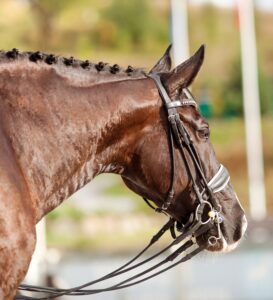
I could go on. Fifteen-year-old me was pretty selfish, and thirty-four-year-old me was seriously down. She got the notion to get her backside on a horse, and lo, that medicine still helps me keep life in a gentler perspective.
 All of these incarnations of Grace are still very much with me, and I have learned from each of them. Maybe this Ages of Me view of myself is part of why I seldom feel lonely. We are busy, us girls, living life and trying to make sense of it, and that’s a team effort!
Do your previous selves and future selves ever pipe up in your life? Do they inspire, guide, or make you wince?
PS: The print version of A Gentleman of Modest Ambitions is available from Amazon, and the first batch of ebook ARCs has gone out. If you’d like an ARC file, please email me at graceburrowes@yahoo.com.
 I am not one to give up on a book I’m reading, but I recently set aside a biography of Frederick Douglass. It was well written, wonderfully researched, compelling, fascinating, and really, really sad. That guy struggled his whole life for a just cause–struggled to the very limits of his human endurance–and saw only inadequate progress, all but thrown away almost as soon as it was won, and now we’re backsliding on that progress again at warp speed. For my nighty-nighty reading, I am not up to the challenge of absorbing that content.
 Bedtime reading, from the time I was in grade school, has been for detaching from the day, going to a place where justice triumphs, truth and courage carry the day, and love conquers all (by the end of the book). It takes about twenty minutes for a good story to reduce our stress by nearly two thirds, improve our sleep quality, enhance our vocabulary, broaden our capacity for empathy, and fortify the neural wiring that supports our capacity for critical thinking.
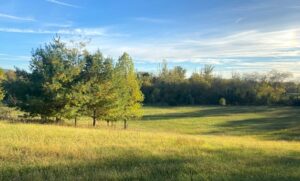 I need to walk where it’s green and growing, in nature, such as old farmland still makes that claim. I found a woods to walk in near the horse barn, and I will be making time to stop there again as the need for shady paths grows in the coming weeks.
 I was at the horse barn this week, taking a mighty steed to his stall after a lesson, and one of the other volunteers mentioned that she was looking for a paying horse barn job. She is mid-twenties, and new to the equine scene, but a quick and enthusiastic learner who has a natural aptitude for working with horses. She was convinced that lack of experience was going to doom her ambitions.
 She just stared at me, and then started to tear up. She’s college-educated but going through that, “Maybe my ladder has been leaning against the wrong building this whole time,” questioning which seems to accompany the quarter-life crisis
 As I was driving home, it occurred to me that my exchange with my barn buddy was a micro-example of qualities I love about my season in life. In earlier years, I might not have been aware enough to realize my fellow volunteer was asking for reassurance in the first place. In the second, I would not have had a ready argument against experience as the sine qua non. Of course, the ideal employee will have some experience, and also an open mind and a willingness to work hard, in addition to a heart for horses, but that wasn’t the point to make at the time.
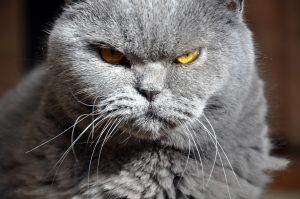 If you want to see me shoot around the room backward with flames pouring out of my nose, just tell me, “We are each responsible for our own happiness.” I’m not sure why I get all riled up at this phrase, but I suspect it has something to do with representing myriad foster children who went from lousy homes to lousy foster homes (maltreatment in foster homes is estimated conservatively at 25% of placements), while being told they should be grateful to have any roof over their heads.
 I do believe that I am responsible for accepting and managing my feelings. I am responsible for my actions. I am responsible, if I’m miserable, for trying to change that. I type those words, though, from a place of enormous, multi-faceted privilege. I am relatively healthy, I am solvent (finally, for now), I am white, I am single, I am dwelling where the air and water are pretty clean, I was taught to read and write… all good things, but even somebody with all those high cards can get wrapped into an abusive relationship, poverty, disease, or all three at once.
 So, this is me with my nose aflame. I’ve posted a
 the words.
 Intimacy (can you appropriately handle sensitive personal information?). As I read that list, I’m nodding along. If a doc is going to prescribe treatment for me, I want all three of those factors in place, but the critical factor is apparently number four.
 Even if people are motivated by genuine altruism, in an environment where greed is normalized and even applauded, we don’t trust altruism and good moral health when we run smack into them.
 stinkin’ thing about a world run amok?’
 The world does not suddenly right itself if I go on a thank-you-birds walk, or if I bring cookies to the barn, or plant a flat of pansies by the mailboxes, but I am a little righted, and that is an excellent place to start.
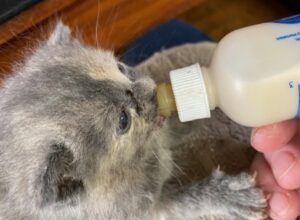
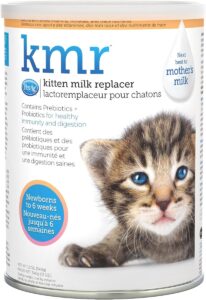 For the past couple weeks I have been bottle feeding a kitten. I came home one night, saw that the corner of the porch where the mama had made her nest was empty. I figured mama cat had moved the nest, as mama cats will do. Well… nope. I walked into the house, and there was this one little gray scrap of feline yelling her fuzzy head off about knowing her rights and this is an outrage and bring me a flagon of ale, wench!
 On those days, I fret and worry and offer the bottle every hour, often to no avail. I hate the dragging anxiety, the dragging spirits, the sense of being unequal to the challenge of getting this kitten safely past infancy.
 When I look back on that season of my life, it was hell. I was alone, exhausted, bewildered, and scared, with no end in sight. People would say to me, “Enjoy these years when she’s little. They go by so quickly!”
 I’ve been reading a lot lately about the value of
  No problem! Just ask your AI assistant for solutions, and in nanoseconds… there you go, complete with recipes, a budget, estimated time to prepare, ideal task sequencing, nutrition parameters, and wine pairings. Friction gone!
 I’ll tell you why: I’ve studied five different foreign languages, and I don’t speak any of them well, but each one taught me something cool about English, or about the culture of the lands that spoke that language. The pay off was in the study, not in the mastery. That is to say, the friction–putting the old proboscis ad carborundum–was the gift, not the grind.
 I don’t want a life of doing what the Bot says I should or watching what the Bot suggests I watch. I want an interesting life, with meaningful challenges, thorny questions, moral accountability, and work that tests my skills and stamina while allowing me to make a contribution beyond my own subsistence. For that reason, I cannot ever see the day when I will write a book in a process that in any way relies on generative artificial intelligence (and also, because much of it is built on piracy, but that’s another post).
 Several experienced therapeutic riding instructors were hanging out in the tack room once upon a time, while I imitated a fly on the wall. They were discussing the extent to which even in able-bodied children, fine motor skills seem to be in decline. The young riders do not wield pens or pencils to the extent their parents did. The children often don’t have to lace up and tie their shoes (Crocs are technically shoes, I suppose); their clothing might not feature buttons, zippers, or buckles when Velcro will do instead.
 One of the instructors went on to lament that she had to show a child how to use a broom (a swept barn aisle is a safer barn aisle). I learned that sweeping with a broom used to be an occupational/physical therapy staple for several reasons. First, it’s simple. No on/off switch, no this-side-up baloney, no left-hand or right-hand limitations. Pick it up and go.
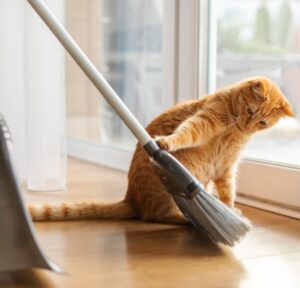 brain at once, which makes learning or even cognitive processing of any sort easier (thus explaining the pediatrician’s delight when a baby starts to crawl).
 In the past year, I’ve seen more power outages at my little farmhouse than in the previous five years combined. Not sure why–high winds, drought, aging infrastructure, or maybe Potomac Edison has been economizing on preventative maintenance in a jurisdiction chock full of big trees?
 I have water, firewood, snacks, and dry pet food stockpiled. I also have candles, matches, and flashlights, but that doesn’t address a need to use time productively or enjoyably. Today’s outage wasn’t quite three hours, last weekend’s was closer to eight. What to do? What to do? If the weather is acceptable, I’ll tackle some yard work, but I’m certainly not up to eight straight hours of outside chores.
 And yet, I always feel a little defeated when I am backed into this option. What if I fall asleep and take a nap? What if I can’t get to sleep tonight because I took a little siesta? What if I run out of books? When will the electricity come back on so I can Be Productive?!
 need a power outage to excuse the “indulgence.” The habit of working just because I can keep my eyes open, is deeply ingrained, and–I know this–not healthy.