



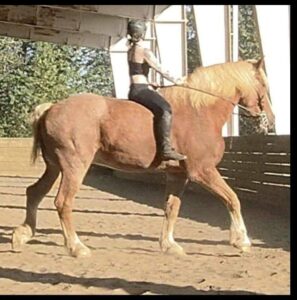
 When schooling a horse, the rider is responsible for setting the horse up to succeed. Don’t ask him for hard things when he’s tired, confused, or upset. Give him generous warm up and cool down time. End on a positive note. When schooling new moves, accept and praise progress rather than insisting on perfection. Listen to him. Give him physical and mental breaks. Reward a good faith try, correct gently, and be patient.
This is just common sense horsemanship. Pester a tired horse for more than he can give or ignore his signals, and he might object dangerously. Expect progress to come too quickly and you could well end up with not only a lack of progress, but also setbacks. Safety and efficiency aside, a patient, considerate, growth mindset is also just what any healthy long-term relationship needs to thrive.
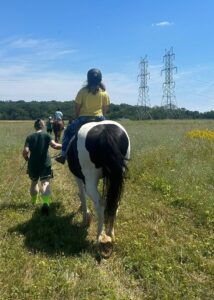 And that objective–a healthy long-term relationship–is more important than any one movement or sequence of jumps.
As I headed into camp week at the barn this year–I made a royal hash out of camp week at my last barn–I tried to treat myself like a horse. What did I need to be set up for success? Well, the obvious thing–rest–was something I could somewhat control. I stuck to a pretty early bedtime, because reveille was at 5:45 am. I did as many morning chores the night before as possible, and I just gave the whole housework thingie a week-long pass (such a sacrifice!). Writing got a pass too, albeit reluctantly (Lord Julian shakes his handsome head and sighs).
I laid in a good store of lunch-able, snackable protein, because the last thing I needed was hypoglycemia making a long, hot day worse. I brought at least a quart of icy watered down ginger ale with me and drank cold water in addition. Heat stress is cumulative. Ask any experienced horse show manager. If the show is three days long, the third day is when all those bullet-proof athletes keel over.
 Several times a day, I made myself do the breathe in fast, breathe out slow routine that brings down blood pressure and kicks in the “rest and digest” parasympathetic nervous system. When another volunteer offered to trade my somewhat antsy horse for her steady-Eddy, I accepted the help. I did not want to be the old lady with the torn rotator cuff because, “No, that’s fine. I can handle it.” I’d been handling it for three days at that point.
I gave myself permission to keep to the side of the room during group activities, to take time outs for five minutes’ peace (nods to Mrs. Large).
 So I’m the old lady who for once got strategic about an obstacle course, and managed five pretty demanding days without crying, cursing (out loud), offending my team, or letting down a horse who should have been able to depend on me. I am a little proud of myself, because a year ago, I did not manage a comparable set of challenges well at all, and I wanted to prove to myself that I could, um, get back on the horse.
Have you ever gotten back on the horse? Made yourself go back and get it right, or at least not as wrong the next time? Or have you wisely thrown in the towel when everybody was telling you to try, try again?
PS: Rough draft of the cover for A Gentleman of Very Few Words. Wheee!
Yes, I did get back on a horse. My first experience with an English saddle earned me a broken nose in the first couple of minutes. I did try again, but many years later, and on the end of a lunge line in a fenced enclosure on a trained horse. Being extremely allergic to hay, it isn’t something I’ve pursued.
There was a local lawyer who said the people he kept out of his office made him more money than the ones he let in. Knowing what you aren’t good at, or don’t want to do, is a gift.
What you said! The whole, “That which does not kill me,” mindset strikes me as a good way to end up seriously injured.
I am apparently not good at remembering things since I haven’t been able to think of anything to post about this subject (another good one, of course). But, since this is the last weekend of June and you are supposed to be on hiatus in July, I want to wish you as much hiatus as you can stand! And, yes, selfishly, I’ll miss your essays. Also, I like your covers for Lord Julian even if they don’t have any people on them.
Thanks, Karen. As it happens, Lord Julian is on holiday at the beach in book thirteen, so I will be at the seaside, at least in my imagination.
I have tried to get back in the saddle with piano several times in my adult life. I have continued to pursue it in retirement, and although I will never be star material, I am pleased to have made some progress both in performing and in just more knowledge of the piano. There is a real difference between practice in the morning and practice in the afternoon, so like a tired horse, I must pace myself.
The cover looks great and very intriguing.
I pretty much cannot write new material in the afternoon. My preference is to get up early and write, “before the day intrudes,” as Ray Bradbury put it. Oddly enough, I can occasionally get some pretty decent material in the evening. Afternoons are for mindless chores, or (I think Dad would understand) a little cribbage on the computer.
I got back on the horse today.
Entered Laci in a nose work trial.
I have a new teacher…new approach, positive attitude, and encouragement. She encouraged me to step out of my comfort zone…attending classes bs trialing.
My dog club is hosting a scent work trial in August and I thought we should practice and see how a scent work trial works.
I volunteered and learned a lot, plus Laci was crated in an A/c room..it was HOT!
Haven’t entered a trial in ages..since Greg’s get me out of here performances in obedience.
I was nervous but Laci knew what to do!
I brought plenty of water, a cool pad for her and used the rear a/c for the ride home.
Laci qualified in all 4 elements- novice container, interior, buried and exterior!
Holy pistol, Sue! That is getting back on the horse and winning the race. Good on ya and good on Laci. Go, dog, go!
I decided when we were set to move from Ohio to Minnesota for my husband’s new job that I would not look for an accounting job. I was a CPA and slightly singed on the edges. Not quite burned out but close. A lady I worked with said it was such a shame my degree and certification would be wasted. I told her it hadn’t been wasted. I’d been using them for years and enough was enough! Time for a new chapter. I don’t regret it one bit.
On the literal front, many years ago I refused to get back on a horse on advice from my neurosurgeon after a borrowed mare fell on me at a jump. One spinal surgery later, I had the beginnings of knowing when to stop & walk away, no matter the well meaning urging of others. Sometimes saying No & shrugging off accusations of laziness or cowardice is the better part of valor.
Many years later I still have to cram a double Pelham on my Type A tendencies & rein in HARD to stop myself pushing past endurance. But I’ve gotten better at stopping before I hit that point of “to the pain” to misquote a movie. And when sheer doggedness is required, at least I know it’s there in the stall, kicking at the door, ready to be let out for a hard run.
Someone give Madame Editor a high five!! Can’t wait!!
Back on the horse? Not as often as I should have.
Here’s one: it took 3 tries to get into the professional program I wanted.
Here’s another: after too many years of “exercise more eat less” my doctor gave me a path through specialists to follow culminating in the diagnosis of a rare muscle deterioration syndrome. No more “exercise more” but I am trying to eat better.
For me parenting is a case of constantly getting back on the horse. So many mistakes, missteps, etc. But you just have to keep on keeping on.
Like Karen, summer has apparently interfered with my ability to stay on topic. (Well, all the Colorado wildfires too close don’t help et.) However, I love the new cover and on- track launch date- and have a lovely July hiatus!
Enjoy your July freedom. See you in August!
My “throwing in the towel” has to do with old, unfinished quilting projects. In searching my fabric closet recently, I discovered four of them and finally told myself that enough is enough; I do not love these enough to put in the work to complete them. Hopefully someone in my quilting groups will be willing to take them on. If not, then hello dog beds!
I have to confess— I came looking for you simply to ask one question.
I *was* entertained and sympathetic upon reading your challenges with horses this summer purely for escapism — I was last on a horse some years ago who had the trick of cantering under a sturdy low hanging branch when she was plagued with an inexperiences and timid rider, and I was summarily dispensed with. 🙂 Therefore, I am quite satisfied to read of others’ equestrian adventures!
My question, however, seems to be about something you’ve galloped past ages ago:
The only place I e been able to locate your Lady Victoria mysteries is in my library. I’ve spent the last two weeks ripping through zVictoria’s adventures one after another, and I’m about to start the second to last book when I saw that Lady Victoria Says I Do in the audio version is not available — seemingly not anywhere that I’ve looked! I borrowed the print version, but my problem is that my eyes have been rapidly failing because of retinopathy, and I have to squint and use extremely glaring lamps to slowly make out the words. I’ve loved to read all my life, but at this point I’m reduced to a magnifying glass, a kindle with giant fonts, or — most comforting and enjoyable— the audio version. I’ve been enjoying Kirsten Potter’s lovely expressive voice for hours and hours through all the stories of Lady Victoria’s sleuthing — she and her suitors and family members clearly have their own voices and accents as well!
So. Finally (I’m sorry to ramble) my question is: can you tell me where I might find the audio version ? Or if it doesn’t exist yet, could you tell me when it might be available at my library? Or if it exists and my Portland, Oregon Hillsdale branch library simply has neglected to purchase it long after it’s been available, let me know and I will harangue them until they do procure some copies! I know from the lists of availability that at least several other readers are going through them, although at a rate somewhat slower than I’ve been able to. I can listen and work at the same time, fortunately!
Any answers will be incredibly much appreciated! I will finish this penultimate one tonight, and then will be reduced to squinting once more unless I can bribe someone to read it to me ( although much less expertly than Kirsten Potter.
With fingers crossed and gratitude,
Gillian
P.S. Needless to say, i absolutely love the Lady Victoria series and I find your writing wonderful — definitely in the first tier by far when it comes to the romance genre! I feel as if the voices are true and beautifully fitting for the period. You’ve used my favorite word, “perchance”, and by then I was far beyond won over.
Grazie ancora / merci encore, 😉
Gillian