






 I recently did a presentation for other writers on the use of child characters in adult fiction. At one point I found myself passing along the following observation: Underdogs tend to be far more knowledgeable about overdogs than conversely. Ask a kid to imitate a parent, and you will get the impersonation to the life, right down to intonation, word choice, and gestures.
Ask students to describe their teacher, ask workers what the boss is really like, ask a victim what they notice about their abuser (be prepared for a detailed reply with that last one). If you put the same kind of question to the dominant party, you are more likely to hear generalities and guesses in response. It’s the difference between paying attention because that’s useful, and paying attention because your survival might well depend upon vigilant observation and recall.
 I think this is part of the appeal of the child character. An Atticus or Winnie or Rose is keeping closer watch on the adult cast of a book than the reader is. When Atticus is being chastised for disobedience, he can retort that Julian disobeyed orders himself–of course, he did–when another adult would hesitate to point that out, if they even made the connection. Atticus was probably ahead of most readers when he came out with that argument, but to a child, keeping track of who obeys and who disobeys is not a detail.
In real life, the ramifications of the “less powerful viewpoint theory” are more complicated. If our most accurate reporters are the underdogs, where do we hear what they have to say? In past centuries, children were everywhere. They worked lived, died, and played–in the fields, church pews, taverns, mines (alas), shops, and streets. Many were expected to contribute something from a young age, and valued as a result. They were seen, regardless, and thus they had a chance to be heard.
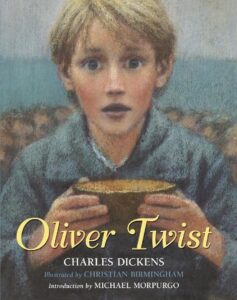
I think often of Charles Dickens’s experience. His father, mother, and younger siblings were tossed into debtor’s prison when Charles was 12. He was considered old enough to support himself, and took on a dreary job as a copyist, working long hours for little pay, and sleeping rough. Because of his early experiences, we have the brilliant social commentary of Oliver Twist and Great Expectations, and the scathing indictment of greed that is A Christmas Carol. Little Charles paid attention. His life depended on it.
Of course, I’m a grandma now. The topic of who is listening to the truth according to the children (among many other less powerful demographics) is much on my mind. I  sometimes think, “Eight-year-old Grace would not want me to set the alarm.” And I don’t set it. Or, “Eight-year-old Grace would tell me to give up on this scene and go to bed.” And I put the scene aside and try again in the morning. She was sensible and compassionate, that younger me, and her advice is usually sound, particularly as it relates to self-care and relationships.
Have you been an underdog? When you were, who listened to you? Are there underdogs who can trust you to listen to them now?
PS: Speaking of Julian and Atticus… A Gentleman of Sinister Schemes is already available from the web store!
I like this framing of the question by you, Grace. Which turns out to be, for me, “What Do I Need Right Now”? A question children are often more in tune with, and often more honest in their answers to.
I’m trying to get better about asking myself that question.
Oh my god, yes, I was the underdog! And my survival and safety in my family definitely depended on it. No one listened to me about that until I sought out someone to listen as an adult.
Good on you, for seeking out someone to listen to you as an adult. So many of us reason that we survived, so we must be FINE, right?
Another excellent, thought-provoking essay about which I have nothing to say. (I hate when that happens!) I have decided to make a comment, even if I cannot actually answer your question, so that you know that your essay is read and appreciated. Obviously, I was a child at some point so by definition an underdog but I was raised to be quiet. Until I became an adult, I acted that way but then I decided I had the right (and maybe the obligation in some instances) to speak up.
As a corollary, I totally disagree with people who want athletes and authors and celebrities of any kind to keep quiet about politics and other injustices. They are people who have to live on this planet, too, and have the right to express their opinion. I don’t have to agree with it but they have the right to speak it. The “just play ball (or act or whatever)” attitude is totally patronizing and seems to come from straight white men mostly. Who decided they get to decide?
Yeah… who? And why?
But I also get that readers/listeners/viewers don’t want a sermon in the places they turn to for entertainment and relief from a stressful world. If I went to church and my pastor instead of preaching started in on his personal rendition of “Jeremiah Was a Bull Frog/Joy to the World,” I would be a bit dismayed.
I am the oldest of four girls. My mother tried to treat us as a group in an effort to keep up with work, kids, household. (I was still put to bed at 7:30 pm as a 6th grader.) As a young adolescent, I discovered that our next door neighbor, in her early 30’s had a listening ear and for me, almost unlimited availability. They moved, but it got me through junior high without totally dispairing. She also loaned me the books from her “keeper” shelf. Jane Austen, mostly. The beginning of historical romance for me!
I understand your reply but I wasn’t really referring to the creative or athletic activity, but to things like newsletters or interviews or posts that occur because of the person’s status. I agree it would be disconcerting if an athlete stopped in the middle of the game to give me an opinion. But outside of that, I am interested in what s/he might have to say on important topics. I might learn something (and more knowledge is a treasure to me).
On the other hand, I would personally prefer “Jeremiah was a bull frog/Joy to the world” to a sermon (I’m very much a “questioner” and have always questioned why the preacher gets to tell me what I should think or do–started way back as a preteen when I went to my aunt’s Catholic church and the women had to cover their hair but the men didn’t and I could never figure out why since hair is hair).
OK, that last comment from me was supposed to be a “reply” to Grace’s comment but it seems the “Reply” link doesn’t work for me. And I suspect this one will also end up as a separate comment. Oh, well.
Underdogs R Us. As a child I was shy, and though I had my friends, I always felt on the fringe of things. Still do. Happily other underdogs were close friends and we listened to each other and got one another through school while the big dogs ran the show. Must have a sense of humor to survive!
I had one particular incident where my underdog opinion was graphically vindicated- I was 12 & we were at the takeout of a kayak/canoe trip down the Rio Grande River. It had been a cold windy day, kinda miserable, but we were “having fun” right? And the trail out of the canyon was 600’ up switchbacks. The weather had gotten worse, the sky getting dark, & the parental units were carrying the aluminum canoe up the trail, & little ole me (being a died in the wool worry wart) said, “ um, maybe that’s not such a good idea?” Which was roundly ignored until lightning hit the top of the rim above the trail and scattered rocks down the trail. Nobody was hurt, but it was definitely a character affirming event. I do listen to small people.
I have spent most of my life in the underdog position. I had and have a reputation for using observations to make accurate judgments about people’s behavior. Unfortunately this is not a good thing because it freaks people out. I have learned to shut up and just keep my predictions in my head. I have learned some important things from my new position. For one thing I am not as accurate as I thought I was even though when I am right I am darn accurate – which people experienced as intrusive. I am pretty old to be finally learning the lesson. I am so rarely in the upper dog position that it scares me more often than not.
Reply to Sue: Loved your observation on noticing things. It isn’t popular, usually. Cassandra’s story in Greek mythology didn’t end well, either.
I have a motto of sorts to never underestimate anyone. Status does not equal wisdom or value or ability. Being underestimated often when I was growing up, I listen to children carefully and I try to keep in mind that those in the background often see more than those in the foreground.
I didn’t know that about Charles Dickens, but it certainly makes sense.
There were only two people who listened to me as a child, my maternal grandparents. Everyone else simply talked at me. I was told by my mother what I thought, what I liked, what I wanted, what I desired to do in life. I was also told very clearly what my role in the family was, I was to do whatever was needed to make everyone else happy.
Well….my favorite color is not blue like my mother said, and the list goes on. Who she wanted me to be was nothing like who I am & who I wanted to be.
It wasn’t until I met the man I married that someone truly listened to me. After breaking 7 engagements no on thought I would actually marry him but I did, and next month we celebrate 43 joy filled years. Never once has he told me what to think, feel or do. It was terrifying at first but this quiet, somber, logical man helped me crawl out of the emotional prison & become the woman I am.
I always listen to kids & youth, to everyone actually. I know more about the checkers at the local grocery store than their spouses probably do. People hunger, crave someone to just listen to them with a tiny bit of compassion.
As for the kids & youth, I spent over 30 years serving as a children & youth pastor. I listened to the small, weird things and eventually I was told the important things. Many of those kids are grown now with kids of their own & now Ilisten to their children. My grown up kids call, email or text me still with the small, weird things in life & with the big, important things too. And I never, ever tell them what they feel, think or what & who they are.
People sharing those little heart breaks, wounds, victories, challenges etc are them giving me jewels from their hearts. Nothing more valuable.
And sometimes when they share the horrors you can put on a cape & go be a superhero. lol
When it comes to underdogs…I have had students disclose things to me that made me cry and rage and wring my hands at what little I could do to fix it. Now more than ever, I am twisted into knots as I try to slap together some kind of lifeboat for them. “If they can advocate for themselves, if they learn to identify helpful resources and use the best persuasive techniques—“
I am rolling a boulder up a hill, again and again, begging them to be kind, to care about truth, to learn to articulate, to research, to argue, and to critically think. If I’m lucky, we gain ground on one or two of those things before they move on. But they have their own boulders, and some of them are far larger than mine ever have been.
But if I fixate on how impossible my task is, I lose sight of theirs.
It’s a heavy load. Best push together.
Catching up on your blog, I always go back and read every I missed, so here I am commenting on a 9-month-old post, heh.
Your post reminded me of a book by Anne Wilson Schaef back in 1981: Women’s Reality: An Emerging Female System. (The book has been revised/rewritten several times since.) This anecdote is not intended to be racist or sexist, merely to discuss differences. I can’t find my copy, but in this particular scenario she had a diverse group of men and women of different races in a room, and asked them to write about white society. The white folks didn’t have much to write, because to us, white society was just … Society. But they looked around the room and were discomfited to see the non-whites scribbling away. The “underdogs” were much more aware of the system, and what parts of our social system were uniquely white. Then the non-whites noticed the whites were uncomfortable – and they stopped scribbling away because they knew better than to make whites uncomfortable.
Forty-five years later, some things have changed but too much has remained the same. 🙁