



What Ails My Valentine?

            A blog commenter recently asked me what, exactly, was wrong with Lord Valentine Windham’s hand that it became so inflamed? Was his whole problem psychosomatic?

            Physician David Worthington, Viscount Fairly, intimates as much, and Valentine supports that diagnosis when he notes (to himself) that the first twinge of pain came when he closed his hand around the symbolic clod of earth that began the process of burying his brother Victor.

            In fact, Valentine has buried two brothers, and hasn’t really let go of the keen grief resulting from either death. He’s lost two more brothers to the inexorable grip of happy marriages, and his oldest brother, Devlin, has also removed two hundred miles north to the West Riding.

            Valentine has been holding onto to a lot of bewildering losses—no wonder his hand aches.

            Except… This is one of my early manuscripts, and as such, has been significantly pared down from its original first draft… pared down by, oh, say 50,000 words. That means there’s half a book I’ve written about this story that you haven’t read, and buried in that half a book is more information about Val’s ailment.

            As a child, trying to keep up with his older brothers while skating, Val had a fall on an outstretched hand (FOOSH). He hid the condition from Her Grace, and by the time His Grace figured out that his baby boy was injured, the affected wrist was healing. His Grace pronounced it a bad sprain (it was a fracture), and tried to tell himself that stoicism even in a five year old is something to be proud of. (Her Grace would have known better.)

            In modern medical terms a FOOSH is one condition that can create a predisposition to carpal tunnel syndrome. Val’s symptoms—worse inflammation around the thumb and index fingers than the other fingers, abatement of inflammation following rest—are consistent with a diagnosis of carpal tunnel. Repetitive stress can play a role in carpal tunnel, but so too, the literature suggests, can chronic emotional stress.

            So maybe Valentine had a case of carpal tunnel that resolved with rest.

            Or maybe it was a matter of him having to let go of what ailed his heart before his hand would heal. I’ve been around a lot of dedicated pianists, and as a group, I’ve noticed they tend not to suffer ailments of the hand—to the contrary, many of them ply their instruments with breathtaking skill very late in life (Eubie Blake, Marion McPartland, Arturo Rubinstein, Dave Brubeck to name a few).

            To answer the question then, I know Valentine’s ailment was at least physical, but David Worthington was right too: Illness can have its origins in the emotions of the heart, and healing can originate there too.

 Have you ever endured an ailment you suspected was more of the heart than the body?

 

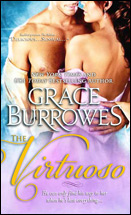
The Virtuoso’s Play List

For each book featured in a newsletter, I’d like to answer a question that either came up frequently on the blog tour for that book, or should have come up frequently and didn’t. The Virtuoso being about a musician, I expected to be asked if I listen to music when I write. It doesn’t say so on the website, but I have a Bachelor of Music degree in music history and my instrument was piano.

When Lord Valentine was acquiring his skill at the keyboard, the entire repertoire of Mozart, Haydn, Handel, CPE Bach, and some J.S. Bach would have been available to him. Over in Vienna, Beethoven would have written all but his ninth symphony, and pianist and composer Muzio Clementi would have been touring to packed houses.

So what did I listen to when I wrote “The Virtuoso?”

Unless you count the contented snoring of my bull mastiff, I listened to silence.

In hindsight, I think I would have been happier had I pursued a college degree in composition rather than musicology, because even more than I liked to create music, I liked to listen to it being created. When I listen to music, my ear is not passive. I take apart what I’m hearing the way an art historian might assess a painting, even the mass produced art hanging in a hotel room.

You hear a string quartet, I hear a cello getting too bossy and a viola hiding under the second violin. I hear magnificent close harmony, or a bass line going muddy as the tempo picks up. In other words, I listen analytically.

I cannot turn this off any more than I can turn off the senses of taste and touch. It’s work for me to listen to music, just as it’s work for me to write. I enjoy both—enjoy them tremendously—but both take focus and effort.

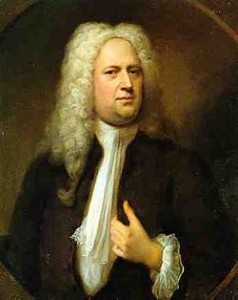
Composer G.F. Handel

So, no, I do not listen to music when I write. That would be like trying to dance and write at the same time—nigh impossible for me. But—and you knew there would be a but—when I was writing “Lady Sophie’s Christmas Wish,” time was of the essence, and a Christmas feel for the book was also of the essence. To help me get a sense of Christmas into the book, I listened to Handel’s “Messiah” (the Christmas portion) almost incessantly when I wasn’t writing. I hummed it, I sang it, I whistled it—and happily “lost” the CD once the book was written.

The neat thing about that work is that even in the Regency period, it was popular Christmas music. Hearing the oratorio over and over, knowing my Regency characters would have been thoroughly familiar with it, helped the story flow more easily.

If there’s a question you’d like to see addressed in a future blog, send it along and I’ll try to work it in. If YOU had written the Virtuoso, what might you have listened to (beside my snoring bull mastiff)?

Web In-site by Grace Burrowes

A new author is warned that publicity will be a significant part of her responsibilities post-publication, and a website is one of the cornerstones of that publicity. I’m not a cyberphobe, but I’m not a techie, either.

And I am a Warp Nine introvert, the same as most other writers. I crave long solitudinous hours filled with only the sounds of my fingers tapping on the keyboard and my bull mastiff snoring contentedly at my feet. This business of building a website loomed for months as the nearest thing to housework: Necessary and a relief to get done, but hardly satisfying.

It will astound you to know my prognostication was wrong.

Having the talented ladies at Waxcreative, Inc., develop a website for me has meant I had to take a look at my author bios, and tell the thumbnail version of the Story of Me yet again in a way that might connect with readers. It means I’ve had to go sifting through my first two books looking for those few paragraphs that will best grab the reader, those snippets of dialogue that surprised me when I first reread them because, what do you  know, they’re good.

This is like looking at baby pictures with a younger version of me as a writer in the background. It shouldn’t be fascinating, but to me it is.

I’ve had to look at the earliest versions of my books for the scenes I deleted, some because they just didn’t propel the book forward, others had to be cut to make the almighty word count. The whole time I was on a scene-cutting revision—killing my darlings!—in the back of my mind, I consoled myself with the thought: I’ll have plenty of material for the website this way.

And of course, some of the scenes I had to cut felt as well written as anything elsewhere in the books. I loved those scenes and cutting them was painful.

Then too, I like websites with interesting little quotes sprinkled around on them, so I pawed through my Bartlett’s, hunting for the perfect words from the great and powerful, and what writer would not enjoy that exercise?

With my website up and running (soon!) I’m going to have my own blog again (to wit), and that means hunting up books to blog about. There is so much good writing out there, so much creativity and graciousness…. With my nose buried in a WIP, I forget about the pleasure of browsing among the websites of the authors who’ve comforted and inspired me as a writer.

And if that’s not enough to change my mind about the fun of developing a website, I hear from other authors how nice it is to be so directly accessible to readers. To get those encouraging emails and to be able to respond, almost real time, with the dog still snoring contentedly at my feet.

Hmm. Suppose I’ll go goggle at the pages under construction. I’ve done enough on the WIP for today and nobody is going to steal my dust woofies. What a wonderful thing it is to have a site under construction.

And how wonderful too, to be so pleasantly surprised by life, once again. To inaugurate the re-emergence of Her Grace Notes from developmental hiatus, I’ll give away a signed copy of “Lady Sophie’s Christmas Wish” to one person commenting on this blog. Just leave some version of your email, and I’ll contact you for more information within the next week if you’re our winner.

Grace


Those Who Don’t Give Up

He’s Given Up

I know a fellow, a friend, who will say upon seeing a fat person, “He’s given up.” My friend is not fat. I suspect his version of struggling with weight is to decide about two weeks out he ought to lose five pounds so he’ll fit into his black suit a little better at his niece’s wedding. He skips desserts and all five pounds fall off.

I carry extra weight and have for most of my adult life. I have excuses—thyroid disease, Lyme disease, stress (my fave)—but I could be doing more to achieve a healthier weight. I could be obsessing, which strikes me as about as unhealthy as toddling around in my well padded, mostly happy, form.

But I have by no means given up, damn it. Every meal, I struggle not to eat more, not to eat the things that will trowel on the lard, to stick to the stuff my naturopath insists will give me “good energy.” I struggle to make myself take walks, to get the heck out of bed every morning and do my barn chores. I struggle when I grocery shop to make good choices, or at least not very bad ones. (Love that little bitty single serve Dove ice cream. Love it.)

As I sit the live long day at my computer, I struggle moment by moment not to get up, hit the fridge, and grab not a carrot stick, but rather, a shortbread cookie. Or a bag of shortbread cookies. Every moment of every day. I have not given up, and I have yet to meet the overweight person who has. We still hope, we still try, we still pray, we struggle and struggle and struggle. But somebody has given up.

The person who looks at me and sees only my overweight has given up on my humanity. To them, I am my weight, and they can walk on by, dismissing me with a single word, or a number. They don’t know I have worlds of creativity and humor and heart inside me. They’ve given up—on me. This happens to blondes, to children, to people who talk funny, people who are short, people who wear pocket protectors, people with babies screaming at them in the produce section, and people with white hair or no hair. They are given up on regularly.

And this is why the company of writers is so cheering. Writers don’t give up. You see a geezer, the writer will see a World War II romance. You see a screaming baby and an overwrought mother, the writer sees a Meet about to happen. You see a tall guy get out of a vintage Volkswagon, and I see an alpha hero about to be mistaken for a beta because he tuned up his little sister’s bug.

I have every book on tape Malcolm Gladwell has made, not because I agree with all his conclusions and like all his methods, but because he has the knack of asking the elegant question, and seeing the answers that appear, not just the ones convenient for him or his readers. This is being a writer. It is also being a human being, not just a homo sapiens. You never get to give up if you’re a writer. Not on the people you see, not on your world, and most assuredly not on yourself.

Reviser’s Block

It has been my happy fate of late to have a lot of revisions to work on. This is good news—it means a book is on the way to publication and it means my editor has spotted places to gild the lily. I’m fortunate in that my editor—Deb Werksman at Sourcebooks, Inc.—will call me first and discuss the needed changes, then send me a follow up email summarizing our conversation.

The email is particularly helpful because ten seconds after we hang up, I am completely at a loss to know what we decided about that pesky adolescent secondary character (whose idea was she, anyway?), or the tweaks needed to make the finale just a trifle more resonant with the opening lines. I know we talked for twenty minutes, I know Deb had some good ideas, I know I have a deadline to make the changes, but other than that…. duh.

The precipitous drop in writing IQ and memory persists throughout the revision process. A new scene that should take an hour to write takes all day; some thread I was supposed to clarify in the dramatic arc becomes invisible to me. I drink more decaf tea, play more solitaire, check my email more frequently when I’m working on revisions than I ever do when I’m creating a rough draft. Revisions for me are daunting and painful. My only consolation is that the sense of rolling a boulder uphill befalls some other writers in the rough draft stage. Instead of having to spend a few days pushing through procrastination and brain fog, they have to suffer for 100,000 words at a time.

Still other writers must struggle interminably to come up with a plot, and most of us—I’m convinced—did not get the synopses-are easy gene. But my guess is that the revision process is largely responsible for improvements in my writing. I can’t view my own books with the objectivity of an editor, if for no other reason than after a 100,000 words, I’m tired of looking at the bleeping things. In the same vein, I think synopses are hard for me to write because I’m not an intuitive plotter. I have to work very, very hard to structure my stories so they fit into a tagline. Holy cow, do I honk at coming up with taglines.

There’s hope, though. I’m working on my sixth manuscript for contracted publication, and the synopsis is already germinating. I’m scanning my prospective secondary characters with a view toward their credibility; I’m watching for threads that go nowhere so I can pull them out before they get knit into my prose. I conclude the revision process is supposed to be a challenge for me because as I’m learning how to make one book better, scene by scene, I’m also learning how to make my writing better, and that will benefit however many books I’m lucky enough to write.

What about you? Is there an aspect of writing that once daunted you more than any other, but now shows signs of coming under control? What helped? What made it easier—or what might make it easier in a perfect world? Reprinted with the kind permission of blameitonthemuse.com

The next time you hear, “Whatever…”

The term, “Whatever…” is said to be among the most irritating comebacks in the language, lazily connoting complete indifference to every possible outcome  and eventuality on the planet.

It means something different to me. Christmas day the heavens gifted us with freezing rain for the duration. It came down for a good while, leaving accumulations of ice in its wake. For those of you who don’t have ice storms, consider yourselves blessed. Snow, you shovel. Ice, you wait for it to melt, hoping it doesn’t take down too many power lines first.

You can’t go anywhere in an ice storm, and if you must go outside (say to feed your horses every stinkin’  twelve hours no matter what), then you will be both frozen and soaked. But it’s good writing weather. The urge to cozy up to any heat source, including a lap top, is irresistible. A day like that brings to mind bleak moors, long lonely afternoons, mind-numbing boredom, cuddling-up-on-a-bleak-day sex, all kinds of scenes and weather driven plot twists. Hurray for freezing rainy days.

I keep a journal, and a few months ago, I got up to a fall-is-coming day. Low humidity, temperatures in the high seventies, glorious, perky weather that fills the body with joy. And that is good writing weather too, for the energy it imparts, the restless glee, the churning mental enthusiasm for life itself. Weather like that brings to mind outdoor sex, picnics, reading in tree houses, and the innocent joie de vivre of many a character at the beginning of many a romance.

A few months before that, I got up on a sultry, still, mid-summer morning. The mercury was headed past 100, it was so hot the bugs didn’t make a sound. The sky was white with humidity, and all I wanted to do was write about parched throats, summer light, and the ease of moving around at night in high summer. That was good writing weather too. In other words, it’s all good writing weather, good painting weather, good child rearing weather, good weather for whatever your creative process is.

The trick for me is to take whatever comes my way—whatever—and smack it off my bat in a productive, meaningful direction. Weather, people, cases at work, flat tires, new dishes, long road trips, whatever life tosses at me, it’s all a gift for the purpose of inspiring my writing, or my legal strategies, or my ability to love my family and friends honorably. Life sucks sometimes, and there are experiences I haven’t found any inspiration from yet, at least that I know of. But determination counts for a lot too, and waking up each day expecting to be given some nuggets of inspiration by the weather, the shopping list, the telemarketer, means I am more likely to find inspiration. Which means I am more likely to look hard for it tomorrow.

This is not a skill I was born with, mind. It’s a product of maturation, not something I consciously set out to work on. There are other names for it besides determination, like ingenuity, optimism, cleverness, resourcefulness. I don’t know about all that, I just know that after years of watching the sky, I’ve learned that it’s all good writing weather if you give it the chance to be.

Sign the Book, Turn the Page

It was my happy privilege today to sign books at Turn the Page, the bookstore owned by Nora Roberts in Boonsboro, MD. Nora was there, and I can tell you, she’s as witty, honest, and gracious in person as you’d anticipate, given her print persona.

Stephanie Dray was there with her very creative novel, “Lily of the Nile,” based on the life of Cleopatra’s historically significant daughter. I also met Jeaniene Frost, Pamela Palmer, Mary Burton, and Mary Reed, who are all lovely women who’ve written fascinating books which I hope to enjoy reading someday soon. I haven’t ordered their books yet, though there is one book I came straight home and ordered.

I was lurking in the back room of the store with several of the other romance author guests when this tall, lanky, fella came by toting a box of books. He wore cowboy boots—which detail usually recommends a man to me—but he was quite focused on riding herd on his stock of books, until one of us interrupted him (well, actually it was me) and asked him to introduce himself. “I’m Vaughn Ripley.” He stuck out a big paw. “I’m one of the longest surviving people to be diagnosed with HIV in this country. I’ve had the disease for twenty-five years….”

This man does not look like any long-term AIDS patient I’ve met, and I’ve met a few. He’s trim, true, and his complexion is pale, but it’s a Celtic sort of pale, not a sickly pale. He has a magnetic smile, a great handshake, and the easy manners of a natural story teller. He is a hemophiliac who acquired both HIV and Hep C through blood transfusions before anyone realized the blood supply could pose those dangers, and yet, Vaughn exudes physical and mental energy.

At the age of eighteen, the doctors told him he had two years to live. He began to keep a journal so his family would have something of him when he died. A few years ago, Vaughn’s wife got a hold of this document, and informed him it wasn’t just a few musings to pass on to immediate family. Because Vaughn listened to his wife, we now have a terrific and very readable book.

I asked Vaughn to what he attributes the miracle of his longevity. We didn’t finish that discussion, but I intend to read the book and find the rest of the answer. What struck me like a cinder block dropped upon my foot from a great height, was that this guy started writing not to get away from the day job or the demands of child rearing, not for his entertainment or financial gain, but out of love for his family and the desire to leave a record when he died.

He wrote in part to snatch a particle of immortality from the jaws of impending death, and he wrote so his love and wisdom would not die with him. In the right hands, writing is THAT powerful. It cheats death, it defies the dictates of mortality, and I would not be a little surprised to find that when used appropriately, writing—storytelling—can also add meaning to a life imperiled by all sorts of medical and spiritual threats. “Survivor: One Man’s Battle with HIV, Hemophilia and Hepatitis C,” by Vaughn Ripley, is available from Turn the Page at the following link: http://www.ttpbooks.com/mm5/merchant.mvc?Screen=CTGY&Store_Code=TTPB&Category_Code=VB or from Amazon at:       http://www.amazon.com/s/ref=nb_sb_ss_i_1_13?url=search-alias%3Dstripbooks&field-keywords=vaughn+ripley&sprefix=vaughn+ripley I’m going to read it, and I’m going to leave a copy where I can see it when I sit down to do my own writing.

January is for Beginnings

Beginnings of romance novels are supposed to be easier—less difficult—to write than ends or (cue ominous music) middles. There is a great deal of business to transact at the beginning of the book. The dramatis personae must strut, mince, waltz, thunder or crawl onto the stage; hero and heroine must Meet and perhaps even enjoy or suffer through their First Kiss; external conflicts must be strongly hinted at if they don’t get center stage; secondary characters and subplots have to get some mention; the requirements of setting must be appeased.

At the beginning of a book, the issue of what to write about is subsumed under all that busyness, and yet sometimes, even the beginning of a book eludes us. The first line won’t present itself. The first scene keeps developing a limp. The Meet has no chemistry. The hero and heroine have too much chemistry and all of it is bad. The secondary characters are too charming, witty, or intriguing to serve in their intended roles. And sometimes, we get into those dark, miserable corners where no words come at all.

We are beginning-less, and then we become very prone to endings. When the beginnings won’t come, we fret that they’ll never come and our writing career is over. We polish and buff and read over old material until we’re no longer polishing, we’re sanding it down to something dull and boring. We consider our own big black moment—quitting.

I attended a panel discussion at a Georgia Romance Writer’s conference on the topic of “When the Words Won’t Come.” Four published authors all discussed very frankly what it’s like to be without any beginnings at all. The room was nowhere near full, almost as if mention of the topic itself had the power to shut down our creativity. In the course of the discussion though, one panelist lead us through the creation of a first sentence, one word at a time. It took better than an hour, while we listened to each writer explain what had robbed them of their beginnings, and how they recovered the gift of starting a book.

Beginnings are fragile, it turns out. They are not easy at all. They take hope and courage and the ability to withstand significant anxiety about middles, ends, and more beginnings. Beginnings can require that we have physical and mental health or financial stability firmly in place. They can demand that we see the end even before we start. They can seize our joie de vivre and creativity and throttle them within an inch of their existence.

I developed a new respect for beginnings at that panel discussion. So the next time a single sentence pops into your head worth exploring, rejoice. The next time a scene occurs to you while folding the laundry, give thanks. The next time your secondary characters have the decency to politely hint they might enjoy having their own book, be grateful. If nothing else has come clear for me, it’s that a beginning–of a book, a relationship, a project, a life– must not be taken for granted, and is a terrible thing to waste.   reprinted with the kind permission of the Sourcebooks Casablanca Author blog

Mazlo’s Geometry

Abraham Mazlo was a smart dude (who spent a lot of time around books and libraries growing up). He posited the idea that we have a hierarchy of needs, with physiological needs—breathing, food, water, sex—coming before security needs like physical safety, job security and consistency in morality, family and property rules. After those came the needs associated with love and belonging: sexual intimacy, friendship and family. Then come the needs fulfilled by esteem—of and by others, of self. Confidence goes on this tier as well.

At the top of his hierarchy are the self-actualization needs: problem-solving, creativity, individual morality, and lack of prejudice, among others. Maybe this is the arrangement of needs best suited to individuals whose priority is perpetuating their genes rather than their ideas, or maybe Mazlo didn’t study too many of the kind of people I meet. In my legal work, I come across people who are so fixed on the need for sexual intimacy or approval, or some other “higher order” craving, that they jeopardize their very lives.

Unless and until they get their emotional needs met, they can’t fashion a life where physiological needs are met. Some of these people are attorneys whom we would call “successful” in the traditional sense, some are convicted felons, and some are the victims of those felons.

In my literary travels, I came across a book called, “Kabluna.” This is a work of nonfiction written by a European who was sojourning among First Nations peoples of the Canadian far north between the World Wars. They referred to him as “kabluna.” The author of this tome met up with a missionary serving in the Artic north, a man who lived more or less in an ice cave eating little besides raw fish. On a calories in/calories out basis, the fellow should not have been able to sustain life, much like many distance runners. The author posited that the missionary was so beloved by the locals, so thoroughly sustained by the meaningfulness of the role he fulfilled in the community, that earthly nutrition was secondary to the spiritual banquet he consumed daily.

I am not now nor have I ever aspired to be any kind of missionary, but I am a writer. My hierarchy of needs dictates that even when food, water, and sex (for God’s sake, Mazlo was a smart guy, but still a guy) are in short supply, I have a need to notice my surroundings. I watch people, I watch animals, I watch myself. I watch the sky and the land, I watch traffic. I watch my thoughts. When my livelihood has been jeopardized or my health threatened, I’ve watched that too.

This is not a dissociative tendency, this is not denial, this is having the mind of a writer. I watch, and I ponder. When I’m driving to work, when I’m falling asleep, when I’m supposed to be dwelling on my gratitudes, my little brain goes off on one frolic and detour after another. This is not Attention Deficit Disorder, or lingering post traumatic stress symptoms. This is having the imagination of a writer. If somehow, somebody got into my mind and prohibited me from watching and pondering, my identity would be jeopardized.

When I’ve watched and pondered for a while, I must synthesize what I observe with my experience and beliefs, and I call that writing. Maybe these are just manifestations of something Mazlo had different names for. They are activities I must pursue to be who I am, and they go on whether I’m fed, loved, housed, befriended or not. And because I do them and others are apparently drawn to do them as well—observe, ponder, synthesize and express—we have what Mazlo placed under only individual morality in his hierarchy of needs: creativity.

I call it culture, somebody else might term it wisdom. Someday, I will reflect on why Mazlo’s pyramid seems to be the inverse of what some Asian philosophies say is the path to spiritual enlightenment, but it seems to me there’s more than one pyramid. So my pyramid might be upside down compared to old Abe’s. Perhaps yours is as well, or inside out, or both. The point is to understand what the levels are on your pyramid, and set about meeting those needs that define you. Maybe you’ll call that writing too.

Plotting Along

The most difficult aspect for me of writing commercial fiction is coming up with the story itself, more specifically, coming up with the external conflict. I have characters galore in my head, swilling brandy, flirting, waltzing, thundering across the countryside on their noble steeds.

I have settings, Regency, Victorian, and contemporary settings that I can see, hear, taste, touch and smell (in my head). I can come up with relationship troubles by the long ton, but current wisdom (with which I will take umbrage some other day) is that a romance novel must have an external conflict, a force keeping the lovers apart even when—somewhere west of page 350 and a whole lot of hanky panky—they realize they are fated to be together.

So after years of wrestling with this deficiency of mine, I’ve come up with two different forms of plotting yoga. (We used to call it brainstorming, but the term has acquired an odor of corporate-speak frowned upon in creative circles.) The first practice involves donning loose fitting, comfortable clothes, sturdy shoes and thick socks. Prior to the session, it’s advisable to stop by the potty, but I try not to read more than one scene while I’m in there because the general premise is that if I move the body, the mind might flex a few ideas too. More than one scene, and well… maybe that’s for another day too.

I go out of doors, I breathe in the fresh country air and hope none of the dairy farmers upwind have cleaned out a loafing shed recently, and I place all my weight on my right foot. Some adepts prefer to start with the left—it’s a personal decision. When I’m confident my weight is securely balanced, I lift my left foot and place it ahead of my right. Calling upon eons of evolutionary engineering, I shift my weight onto the left foot until I am balanced thereupon. Next—and this is crucial—I lift my right foot, and place it ahead of the left. It can be confusing until you get the pattern: left foot, right foot, left foot, right foot, lift, shift, lift shift (say it three times fast).

I continue in one direction for about a mile or until I get an Idea, then I execute one 180 degree turn—this takes practice—and repeat the sequence until I’m back in my own yard. I thought up this very blog in the midst of such a session, proof positive that it works. Or proof of nothing in particular. The second form of plotting yoga, which I truly do enjoy, requires a call to the Beloved Aged P’s on the West Coast to transmit a warning that there will be a Grace Sighting in about four days. I gas up Beloved (paid off) Toyota Tundra, lux some undies, say my grandmother’s prayer for everybody’s safety, and Head West.

I do not listen to the radio, nor to CDs, nor even books on tape (unless they’re by Malcolm Gladwell, of the wise, sexy voice). Long about Oklahoma, I’m fairly confident of having a plot. I once dreamed up a whole trilogy on the road, but this required a sortie through West Texas, about which, the less said the better, except it wasn’t a very good trilogy. To write novels, I need to apply the fundament to the chair for long, long hours, but for my process, for my stories, I also have to find the white spaces in my life that generate new ideas, and if I don’t have white spaces, I have to create those too.

Or I could just go for a walk, or maybe go see the folks.

reposted with the kind permission of blameitonthemuse.com What are the dull, boring necessary aspects of your process that constitute your personal “writing yoga?”