



 Last week I wrote about how a trip to southern Utah gave Lord Julian’s work in progress a boost, but since I’ve come home, I’ve seen a few other boosts as well. First, and maybe most significantly, I’m sleeping better.
Why? Because to get to the site of my family reunion (Capitol Reef environs), I had to go very short of sleep one night, and then less than a week later, I took a red-eye home, so no sleep that night, which I did not enjoy (see restless leg syndrome at 38,000 feet). I napped upon landing, but not for long, and now, a week later, my sleep cycle still seems to be enjoying a benefit. I’m sleeping well, not just thrashing around in bed while it’s dark outside.
 And when I sleep well, everything goes better.
Another boost came from being at high altitudes (7000+ feet above sea level, which is high for me). I got good doses of Vitamin D without sunburning, and I probably made some extra red blood cells frolicking around up there in the thin air.
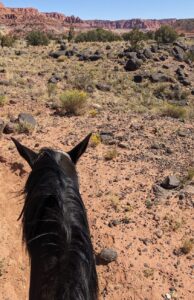
I got to trail ride with my daughter, something she set up for us that we haven’t done together for… twenty years? That did my heart more good than even abundant red blood cells. At one point, I got pretty rattled in the saddle. Because the horse ahead of us stopped, my mount had to halt at an awkward angle on a steep, narrow trail into a ravine. But I do know how to ride, the horse knew how to navigate the trail if I’d just leave him in peace, and we managed. Phew! and also, in a modest way, “We did it!”
Because I needed a pet sitter to look after the beasts while I traveled, I simplified my cat-care routine. Stripped it right down to bare necessities (well, the cats’ idea of bare necessities). Now, my pensioners do not expect private gourmet dining on separate 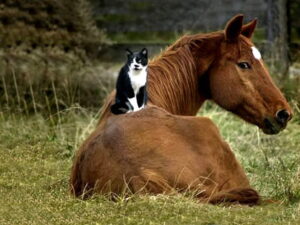 plates in the kitchen, while the rank and file scarf the usual rations outdoors. I also cleaned out my fridge, because the pet sitter would be rummaging around in there, and … really, it needed doing.
I weathered the pandemic pretty easily, from what I gather, and that makes sense. I thrive on large amounts of solitude, I’m pretty self-entertaining, and I have a voracious reading habit. Then too, I was working from home before it was popular–I was one of the lucky ones. Nonetheless, all that hermiting caused my courage for adventures to 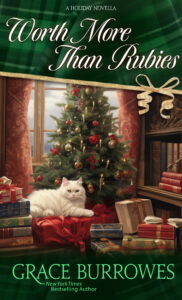 atrophy, and what courage I do have went to dealing with long haul COVID, economic uncertainty, and the stresses we all put up with for some very challenging years.
I’m reminded though, that adventures can bring happy surprises–good sleep is a very happy surprise–and that the courage well can be replenished in manageable doses, if I can just lure myself, even by baby steps–out of my comfy-productive ruts.
When was the last time you had to draw on a little extra courage? I’m still giving away ARCs of Worth More Than Rubies, though the ebook is also available from the web store, and the print version can be purchased from Amazon.
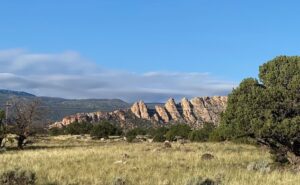
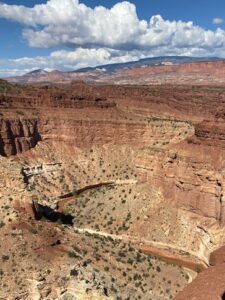
 By the time you read this, I will be back home, but my recent travels took me to Central Utah. You know… Capitol Reef, Escalante Canyons, scenery without compare. I got together with much of my family, something we haven’t done for five years. We come from all over the country, the nieces and nephews attend as they can, and it’s generally fun, meaningful, a little intense, and a little taxing.
 I get stuck a lot when I write, but I find Cory Doctorow’s prescription comforting. (You don’t need to know the whole route, but you can get there safely even in the dark if you just don’t overdrive your headlights…) I tried my usual coping mechanisms–sleep on it, put it away for a couple days, read from the start of the draft, re-read the last book in the series, do some reading on creativity, eat chocolate, take unplugged walks, go to the barn.
 Fortunately for me, I did the drive down from SLC with my nephew Jackson, who served two years in federal prison for protesting George Floyd’s murder. We talked. Jax sees his incarceration as something like an enforced stay at a particularly weird monastery. He learned a lot, about himself, about socializing in a fish bowl, about poker, about power.
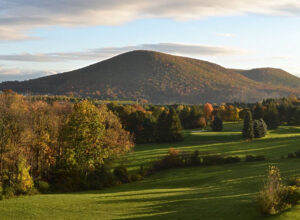 I grew up in the semi-agricultural zone between a major university town and a historic village on its outskirts. I lived in a neighborhood–not a development–though only one side of our property was bordered by another house. The rest was woods, fields, or park.
 Another neighbor paused while walking her dogs to catch me up on some memories her 98-year-old dad has of the house where I live. The girls from half a mile down the road have been stopping by on their bikes to gush over a litter of kittens now calling my porch home. (Yes, those kittens WILL be fixed.)
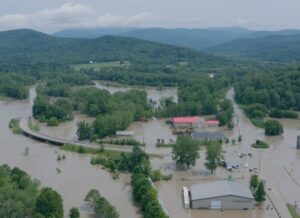 humanity’s future, see his book,
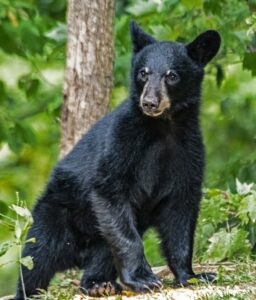
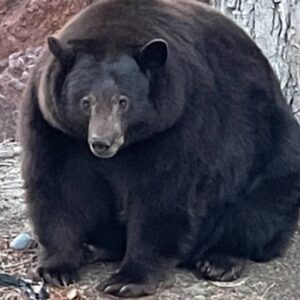
 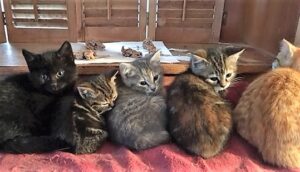 Neighbors in Vermont, according to McKibben, neighbor. Public institutions fulfill their mandates reliably. The benefit of the doubt is still given, and kindness is always an available default. People show up for one another. McKibben’s point is that if we let the mess we’re in continue to divide us, we’re doomed, but there’s a way out of the trap that begins with backyard chats, shared appreciation for kittens, and gratuitous bear alerts.
 From time to time I come across references to Rev. Gary Chapman’s book,
  And I like to be of practical use to those I care about. At the therapeutic riding barn, I don’t care if my job is mucking stalls, side-walking in silence, or horse-leading a reluctant pony. I just want to be useful to a good organization. I’m happy with quality time as an expression of caring, but less comfortable with gifts. Affection isn’t casual with me, either.
 darned shame. When some guy says all the things but never offers to grab the check, and I’m smitten just because of the smarmy words, that’s another kind of darned shame.
 My dad was a great appreciator of what he called the elegant question. As a bench scientist, his work moved forward if he asked the right questions, and then tested his hypotheses in a precise and linear fashion. He was very interested in how correlation could shift to causation–how do you prove that light alters flavor compounds in milk, when it might be time making the difference, the nature of the container, exposure to air…?
 making roadkill of the author’s joie de plume.
 That wonderful lady, who had once upon a time loved truly and with her whole heart, would have counseled divorce. She would have wanted her husband to be safe and happy and away from the relentless despair and drama.
 Sleuths in mystery novels (waves to Lord Julian) are always supposed to ask: Who benefits from the commission of this crime? And when they answer that question correctly, they can often ditch some red herrings and false clues.
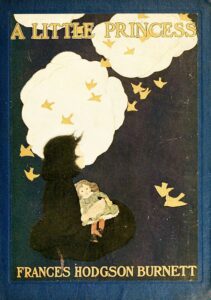 I attend a lot of writing workshops and webinars, and one perennial focus of the big presenters is, “Why should anybody read your book? Why read any book?” The answers to that question generally fall into two categories–we read for education (The Seven Secrets… The Insider’s Guide…. The Successful Person’s…), and we read for entertainment. (The Midnight Library; The Boys From Biloxi; Red, White, and Royal Blue…)
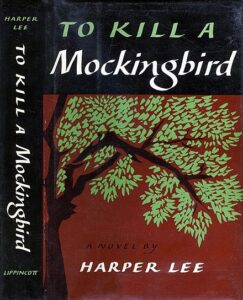 We read those stories for entertainment, but entertainment doesn’t stay with you for decades, providing encouragement, inspiration, and fresh perspectives. The great spiritual teachers didn’t turn to parables, fables, jatakas, and myths because they hoped for a lot of positive reviews on Amazon. They wanted to impart concepts and viewpoints that couldn’t be accurately conveyed or given adequate impact without the mysterious power of story.
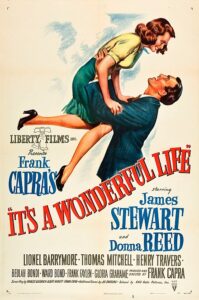 We are more than students in need of education, or economic drones who must be humored with escapist entertainment. To me, good stories affirm the wondrous potential of our nature, give it voice and inspiration, and resonate with that magnificence inside each one of us.
 I’ve been trying to drop some weight lately, and it’s not going well. It never goes well. I am not a glutton and I have plenty of self-discipline, but as my dad once said, I also have a metabolism suited to weathering an ice age. “Just wait 12,000 years, Grace. Everybody’s going wish they had your metabolism.”
 Then I go to the therapeutic riding barn, where one of the lessons I assist with is for a young man who has cerebral palsy and scoliosis, both of which are likely to progress. I don’t know how he has the courage to get on a horse, much less how he stays in the saddle. But he does–every week.
 My mood lately is irritable.
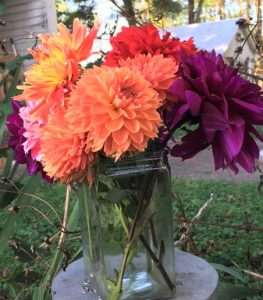 The adult me knows I’m very, very lucky, and my life is awash in blessings. The less philosophical part of me is looking (grumpily) for reasons to smile, and here is a little bit of what I’ve found this week:
 I like that my most recent COVID booster–and all my COVID boosters–have been free. Yes, I know, our tax dollars paid for them, but a) the drug was available, and b) all I had to do was ask the nice pharmacist if I could be vaccinated, and within 24 hours, I had another little shot of safety. I’ve scheduled air travel in upcoming months, and this was a box I needed check.
 Every slight to a person’s good name has to be personally addressed, and personal integrity is highly valued. Personal status and personal accomplishments affect influence and standing–none of this created equal baloney. Whereas a dignity culture might become excessively litigious, an honor culture can descend into bloody feuds and vigilantism.
 That being the case, Julian is surrounded by people who still value symbols of honor. Signet rings, family titles, dueling scars, regalia of office, and military forms of address carried into civilian life all made sense to Julian before he became a prisoner of war, then an injured veteran. By the time we meet him, he’s a man in transition.
 Julian still has a badge or two of honor, though. Because his eyes were damaged by a battlefield explosion, he needs tinted spectacles to deal with strong sunlight. He wears them with pride, always has a spare pair on hand, and soon becomes closely identified with them in larger society. They announce to the world (that feels entitled to judge him unfairly) that he’s suffered for his country. His specs also afford him some privacy, to the extent that the eyes are windows to the soul.
 If you try to look back past more than about a month of my blog posts, you will find I have de-published ten years worth of weekly material. I did this, because Google has
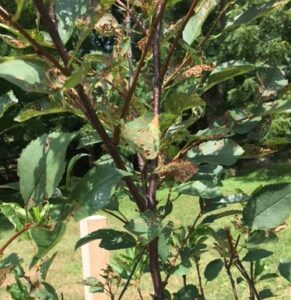
  The situation with AI encroaching on creative livelihoods generally has me down. The wretched heat has me down, as does the thought that we might look back on this summer as “before it really got hot.” Summer is never a great time for book sales, and the stinkin’ Japanese beetles got after my little cherry trees before I even knew Japanese beetles liked cherry trees.
 I was really not in the mood to get on the dreaded tread desk yesterday evening, so I… went to the pool.
 I took about a half dozen turns off the one-meter board, though I didn’t have the nerve to do that one-two-three-bounce prep that presages a really good upward arc. For no reason I can explain, by the second dive, I was giggling at myself. I am no sylph, and when I leave that board, it doth bounce, but ye gods, I had fun. This is a joy I can still claim, a little micro-accomplishment (from when I was five) that still resonates.