






 I recently finished reading The Man Who Broke Napoleon’s Codes, by Mark Urban. This very readable book recounts the progress of one Major George Scovell both as Wellington battled his way across Spain, and as George battled something called the Great Paris Cipher (code) while serving under Wellington as an assistant quartermaster. Wellington won in large part because George won first, but His Grace was parsimonious in praising Scovell. When peace meant Scovell fell on hard times, Wellington apparently did not even acknowledge his cryptographer’s one plea to his old boss for help.
Wellington had a bias against any military system that promoted officers based on merit, and most particularly against officers who had come up through ranks on the basis of outstanding performance. When Scovell widgied his way into an officer’s billet, he had left behind the august position of tailor’s apprentice.
 Wellington’s argument was that elevating men who had no connection “with the land,” (meaning ownership of real property), would result in revolution. Exhibit one, of course, was France. Give these base-born guys a taste for power and authority, inure them to violence, and next thing you know, the scum of earth, as Wellington referred to his largely Scottish and Irish recruits, will be breaking down the palace gates.
Throughout the Peninsular campaign, Wellington had first-hand evidence that officers drawn from the peerage could be disastrous in command, and officers risen through the ranks quite talented (and somewhat conversely). Still, he did not change his mind about who should be an officer, and how they should get the job (essentially by buying in). The fact that the French army, with its merit promotion scheme, was pretty much beating the breeches off everybody else was also insufficient to give His Grace pause.

Credit:: Wikipedia
Nothing changed Wellington’s mind, no matter how deadly the bungling of his less competent aristocratic officers (much less his own bungling) became, no matter how great the contribution of his officers from humbler origins.
I contrast Wellington’s intransigence with an exchange I had on social media, on the topic of Wellington’s traffic cones. In downtown Glasgow, you will find an equestrian statue of His Grace, and usually, somebody has put a traffic cone on the duke’s head. His horse gets a few from time to time as well, and sometimes, as many as eight cones will be stacked atop the ducal bean. The constables regularly remove the cones, and in the dark of night, somebody replaces the duke’s millinery.
A commenter was offended that anybody who risked his life to defend his country (Wellington, and he absolutely was in mortal danger on many occasions) should be the subject of ridicule, When it was explained (by me) that this was a Scottish context, that serving under Wellington was much riskier than being Wellington, and in point of fact, the Scots had always been deployed to the scenes of the worst fighting and taken  horrible casualties under His Grace… well, the commenter modified her stance. She still didn’t find any humor in the tradition, but she understood why, from a Scottish perspective, traffic cones might have some validity.
She changed her mind. Not radically, not on a major issue, but she could admit of more than one valid perspective.
On the one hand, I don’t expect I will change my values very easily–be kind, tell the truth. You won’t get me to budge very far off that prime directive. But my opinions? My theories of human behavior? My cherished prejudices? I would like to be more like my Facebook friend, who could yield a little in the face of new data, who could accept that reasonable people can differ.
When was the last time you changed your mind? Have you succeeded in changing a mind set on some fixed belief?
PS: A Gentleman in Search of a Wife goes on sale at the retail sites Friday!
 I was put in mind this week of a scene from one of the Beethoven bio-pics.
  And you cannot watch that scene without your heart breaking for old Ludwig. He was a difficult uncle to his nephew, ungracious to some of his patrons, a demanding friend, tight-fisted, and cranky, but by god, he earned that applause. Precisely because he was difficult, lonely, and insecure, he deserved to take to heart every bravo and “Bis!”
 I understand that we should remember hurts and harms, the better to guard against them happening to us again. That’s sensible, within limits, but where is it decreed that we should brush aside accolades, minimize them, and even mistrust them? Invariably, when I am having a bad writing day, and my book hates me, and the whole manuscript is the worst draft of anything ever to ooze out of the fictional swamp, a reader will email me out of the blue: I have read everything you’ve written and please don’t stop writing. I re-read your oldies until they fall apart in my hands and then I buy a new copy.
 I woke up Tuesday morning in an inordinately good mood. The alarm wasn’t due to go off for an hour, I’d slept badly, and my right ankle was hurting, but my outlook was rosy. The sound that had awakened me was my upstairs cat, Augustus, purring next to my pillow. How could I not love that guy?
 But an increasing body of
  As Wellington’s army advanced across Spain, his night pickets were always careful to keep some grazing horses nearby. The soldiers on guard duty could not hear French snipers skulking in the undergrowth, but the horses could. The soldiers knew that if the horses stopped nom-nomming at the grass, that was a change in the soundscape even a sleepy private would notice.
 I know some things about myself.
 the distractions, have a nice chat, and get back to my pothering, but if I plan poorly, and schedule myself five or six days out of seven tearing around to appointments, errands, and obligations, I pay for it.
 rested, less anxious, and not as grumpy (most of the time).
 I am considering attempting to become a certified therapeutic riding instructor (CTRI), a process which takes at least two years in the normal course, and involves everything from learning first aid to mucking stalls to spending a lot of time working with seasoned instructors.
 It’s a lot. I ask myself: Grace, you are Not Young, you are no sort of athlete, you have little formal training in disabilities, mental health, OR riding pedagogy. WHAT are you getting yourself into?
 mothering, the everything, and more or less getting it all done. I look back on that phase of my life and just shake my head, but good on me for enduring and to a modest extent conquering the challenges before me. (And I readily admit, I enjoyed a ton of privilege in those years too, and I largely brought those challenges on myself.)
 the battle of grit armed with a lifetime of stamina, wiliness, humor, and love, because those end up being the merit badges that really, truly do matter.
 Once upon a time, I was making a bad job of being pregnant. I was sooo morning sick, the whole way through, though working full time and going to law school five nights a week might have had something to do with my misery (and I was broke). I fainted regularly and I was anemic even on mommy-vitamins. I do not recall that time in my life fondly at all.
 What I got instead was wisdom. Said my sister, who is a mom four times over, unto me: This is not the time to castigate yourself, second guess your instincts, or run yourself down for past choices. You have done the best you could. Right now, just keep around you the people who are supportive and tell anybody else to get lost. That’s your focus and your job. The rest of it can all wait until you have the bandwidth to deal with it.
 I’m struck in hindsight by how much I did not need information in that moment. I had a ton of facts in hand–how motherhood impacts earning capability (not for the best, in too many cases), how single parenting impacts children (ditto), what my options were if I had to drop out law school because the pregnancy became high risk (which it did do, of course). Facts and knowledge and data had reached the limit of their helpfulness and were in fact, making the problem worse.
 summarized in a social media comment, but something about her deep understanding of me–with whom she had played Barbies by the hour–illuminated what she chose to say and how she said it.
 I was sitting in an airport not long ago with time on my hands (three hour delay), and so I watched the passing scene. I noticed how unique our footwear has become.
 Mass produced. This got me thinking about clothing in Regency England, which might have been “ready-made,” a new concept for the time, but was in the vast majority “bespoke.” Your clothing was created, or at least altered, to fit you. If your household had any sort of means, you chose the fabric and the color (or your mama did), and the cut was designed for your particular dimensions. Even the London tailors turning out the standard gentleman’s morning coat had brand-specific patterns to distinguish their coats from the other guys’ and they measured each customer meticulously to ensure a perfect fit. (Just for fun, speaking of which, some
 I have in the entirety of my life, come across a few outfits that felt luscious on me, were the right colors for me, and made me feel more ready to take on the world. They flattered my physique and reinforced a persona I wanted to project. Part costume, part robes of state, and perfect for me. I have seen that mountaintop, though not often and not for decades.
 “How do I want to look?” was a different question for them than it has been for me. I have considered the query successfully answered if I looked “presentable.” Maybe it’s time to up my game in the sartorial department, and now that I am less wide, maybe the project has a better chance at happy outcomes. I look good in raspberry, for example (most people do). I like purple with dashes of green and peach…
 By now, I hope everybody has seen a video of skater Ilia Malinin’s world champion
 Sherpa mountaineer Tenzing Norgay and New Zealander Sir Edmund Hilary did the impossible when, as part of the ninth British expedition to make the attempt, they summited Mount Everest.
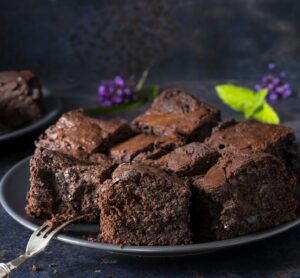 A broken barrier is an inspiration, for better or for worse. I’ve only broken one memorable barrier (so far), and that was when I was in eighth grade. I’d taken a year of home economics in seventh grade because it was “mandatory.” A semester of sewing, a semester of cooking. I already knew how to bake brownies, and I could stitch up a split seam. I did not consider that the first year of home ec had any value, and I wasn’t about to endure a second.
 between music history and pre-law so I obtained degrees in both. I played both jazz and classical piano. I studied both Spanish and Latin in high school. Making one choice at age thirteen to color outside the prescribed lines led to other choices, and I am richer for having gone astray.
 I saw a post go by that made me think about how much more easily we were thrilled in childhood. Pizza for dinner was a thrill, Christmas morning was a big deal, the first snow flakes inspired our rapture, and school letting out was cause for giddy elation. We were thrilled by rainbows and cupcakes and sparklers… Life was wondrous (except when it wasn’t).
 Do you know what’s truly wonderful? A leaf blower. I was on evening barn chores detail earlier this week, and one of the last things you do before lights out is use the blower on the aisle. All the little bits of hay and chaff and horse poo go whooshing down the aisle before you. You can make the dirt dance, ricocheting your dust devil off one wall into the other, and when you’re done–ten minutes later–that barn looks like Martha Stewart’s horse lives there.
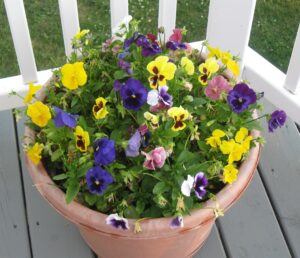
 Pansies are wonderful–they scoff at snow. Shopping at the garden store is wonderful (IN MODERATION, Grace Ann). I got to provide a little assistance on a grant writing project this week, because federal procurement and I go way back. To use what I know in that regard was a real kick. That the landscaper is coming to till up my new forty-foot long pollinator strips (two of them) is great fun. That I found a glimmer of a plot idea for Lord Julian’s sixth tale is glorious.
 Lately, I feel overbooked (though not yet overwhelmed). For no particular reason, a lot of to-dos have converged at once. The car needs new tires, somebody had better file both business and personal taxes, I’m at the end of my COVID booster window and contemplating plane travel (to see the new grandson, of course), and kitties need various kinds of attention from the vet. A lot of running around and feeling scattered.
 The sunlight is more abundant and brighter (before the leaves come out). The landscape is popping with colorful flowers and trees in bloom. I wake to sunshine in my room, even after the time change (all together: Boo, Hiss, on the time change). I spend less energy wrangling fire wood or simply maintaining body temperature.
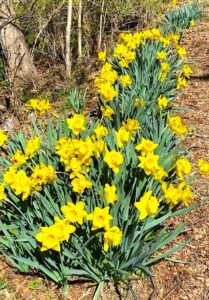 The beautiful flowers and their bright colors. (Somebody should have pruned that forsythia bush by the barn. I wonder who it could be?). The pleasure of not having splinters in my fingers nigh daily from feeding the wood stove its many meals per day. The litter boxes going for days without use because it’s nice outside. The smell and feel of sun-dried laundry. The joy of working in my flower beds. The beautiful sound of the stream greeting me first thing in the morning and the equally lovely chorus of birdsong.
 For now though, I can put my tweezers away, and be grateful not to need them. I can ease up on the litter-box patrol (some), I can dress in less than three layers (whee!), and leave stuff in the car without fear that it will freeze if I don’t unload it before morning.