






 Taking the first few micro-steps toward certification as a therapeutic riding instructor, I’ve bumped up against a hint of the same frustration I felt with corporate America (three Fortune 100s and a pair of Fortune 500s way down on the resume page). By decree of the national certifying organization (not by fiat of the particular barn where I’m in training), riding lesson plans are supposed to adhere to SMART goals (Specific, Measurable, Achievable, Relevant, and Time-Bound).
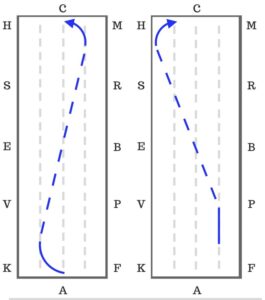
Example: In the course of a one-hour lesson, the student will ride a serpentine pattern of five cones at the sitting trot twice without knocking over or missing any cones. Assuming the student can manage the sitting trot and do some steering (neither is as simple as you might think), this goal probably qualifies as specific, measurable, achievable and so forth.
 Criticism of the SMART goal approach usually leans toward its tendency to reward plodding and complacency. If every goal is achievable and relevant–no moonshots, no frolics, no experimental products–many opportunities for growth and positive momentum will be lost. We will tend to set goals that are “in the bag,” or nearly so, lest we risk failure (cue scary music). In reality, this spiffy management heuristic often actually undermines good performance rather than enhances its likelihood. We “successfully” aim low over and over again when asked to set SMART goals.
But Grace, you say, pie in the sky, “I had a good time with my pony,” isn’t going to result in a lot of progress either. These are riding lessons, not riding frolics. Oh, fair enough, but SMART goals have no basis in science when applied to physical activity. They were the brain child of a management consultant who saw that vague goals in a business context could result in wheel-spinning and lack of accountability. He meant well, he had a good point.
And now we have hundreds of peer reviewed studies proving that if the aim of his methodology was to inspire improved performance, his methodology seldom works as intended, and often has the opposite result.
 We’re still using his methodology. We are still using, even insisting on, a lot of bogus methodologies.
Public school teachers are supposed to develop lesson plans that incorporate different learning styles, when in fact, the myth of learning styles (myth is the American Psychological Association’s term) can be detrimental to effective teaching. Not-for-profits are still politely handing out the Myers-Briggs personality “test” at the annual off-site when that too has no basis in science whatsoever.
I am very lucky, because the instructors and mentors at my barn clearly grasp that there are prescribed rubrics from the national organization, and we respectfully comply with them and grasp what they are trying to achieve. And then there is a child who just wants to enjoy an hour with a dear old pony, and with a little ingenuity and determination, the two agendas can be complementary. All good!
But I realize as I consider this topic, that part of the reason I never climbed corporate ladders very well–at Fortune 100s, not for profits, or anywhere in between–is my fear of the kind of collective inertia that propagates myths, fads, and out-dated models. It’s hard enough for me to give up my own biases and wrong-headed notions (what very few I have, right?). I don’t have the chops to deal with treasured ignorance of institutional  proportions.
I am not the person who in a group context can say the emperor’s tushie is showing, so I just tend to avoid empires as much as I can.
How do you cope with situations where the group is on the wrong path and content to remain there? Do you leave the group, back up a few steps, mutter to your besties? Say nothing and swerve the issue?
PS: The first batch of e-ARC’s will go out/has gone out this weekend for A Gentleman of Unreliable Honor. If you’d like one, email me at graceburrowes@yahoo.com and let me know what device you read on. I can’t send files to everybody who asks, all the time, but I will get out as many as I can.
 We have abruptly entered my favorite time of year–autumn. Maryland might still get some hot days, but those are likely to be outliers now that we have less sunlight. Nights are down in the fifities or cooler for the foreseeable, which suits me Just Fine.
 I suspect I am particularly sensitive to noise, but too much of it is bad for us. Excessive noise has been linked to hearing loss (no surprise), and it also
  So there I am, in the passenger seat on my first ever ride-share app experience, dreading the dentist appointment that awaits me (it went fine). Within five minutes of me getting into the car, the driver and I agree the ride share business model is disgraceful. All the risk is on the the driver and the passenger, but the app is keeping at least half the revenue, if not more.
 ago.
ago. Where my driver came from, I would not be allowed to read in public, much less publish books, much less go to the dentist without an adult male escort, assuming I was allowed to go to the dentist at all.
 My house is old by American standards, a log cabin that dates back at least 180 years. The upside is, the basic bones are sturdy. With reasonable care, this dwelling should still be standing in another 180 years. The downsides are legion.
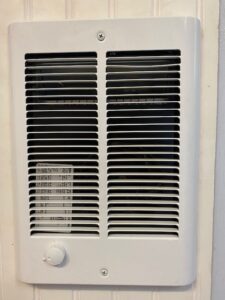 My neighbor figured we could frame the heater with bead board and improve the look significantly for very little cost. He got to work and found that, welp, the general approach was valid, but the little bead board frame thickness was enough to create a gap where the juice was turned on and off, and…
 Fortunately, my neighbor is a kind, patient man, and he gave me the time and space to calm down and sort myself out. I knew I was egregiously and badly mis-reacting, but the sense of upset was very real. Something was going on with me.
 has to go. Evidence of intermittent infection. Warranty expired, no replacement parts available (though we might do an implant). I am scared of the procedure, scared of having to use my first ever ride share app, and scared to think my tooth is a just harbinger of a lot of changes to come.
 Maybe this hasn’t been such an easy year (so far), and all of that upset and anxiety got stuffed into a quarter-inch gap, and I nearly didn’t see it.
 I can well recall two little pieces of paper taped to the inside of my dad’s bedroom closet door. One said, “Look sharp, feel sharp, be sharp.” (This baffled me as a kid. My dad was old and bald. To whom could he have been giving fashion advice?) The other said, “Can I do without, fix what I’ve got, or use something else?”
 I have since kept my nose in the wind, sniffing the breeze for useful questions. “What is the problem we are trying to solve?” can cut through a lot of squabbling and subtext or illuminate mis-matched agendas in a group. “What is the smallest, easiest step I can take in the direction I want to go?” can get me off my duff when I’m feeling daunted and despairing.
 I wondered when I read the marketing description for Adrienne’s presentation what could have inspired her to blend these two apparently distinct circles? The answer is… a “dreadful” experience in a grief counseling situation. Adrienne had sustained yet another loss in a life overly full of bereavement, and had signed herself up for a program dealing with loss of a loved one.
 include in my collection of useful questions, “Ok, I’m disappointed. Maybe bitterly disappointed. Could I do a better job than this person did? How? What would set my mousetrap apart? What is my disappointment telling me about how to achieve a better outcome? How can my disappointment inspire me?”
 One of the many things I love about growing older is that I occasionally stumble into situations where I can combine skills and experience gained in different parts of my life.
 Similarly, I love to write fiction, and I love horses. When I can build a horse and rider relationship into a story, I am having big fun. Lord Julian better be careful, because he and Atlas are buds, and I foresee a possible horse thief in their future… Oh nos!
 If I’d dodged motherhood, my understanding of children might still be well informed, but it would come from a narrower perspective. If I’d never taken on flower-erizing my own property, I would not grasp quite as easily why deer who nom-nom all the sunflowers in a single night are justification for profanity (they got my first foray into grapes too, the miserable blighters).
 When, five minutes later, another rabbit cuts from the undergrowth, your horse hops again, snorts again, and halts abruptly. You pat him. “Silly horse. It’s another rabbit. Stop trying to mess with me.”
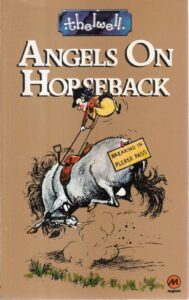 At some point, the same stimuli that caused only a stop and hop, if compounded, causes a full horsey meltdown.
 One feature of Dense Discovery that I particularly enjoy is the Worthy Five, which asks five questions of an individual whose biography might be “graphic design survivor and mother of twins….” or, “cartographer and bread baker.” The emphasis is not on what the contributor has accomplished, but on what they’ve learned along the way. One week’s worthy five might be an interesting quote, a worthwhile podcast, a great recipe, a light bulb concept, and a website that is truly worth a visit.
 One insight that has cut across many of my domains is the distinction between expressive language skills and receptive language skills, and how the people who talk the best game might actually be deficient when it comes to the other side of the coin. What do I mean by this?
 Somebody who talks a great game doesn’t necessarily have the receptive language chops that a much less flashy or “successful” person in the same field might bring to the table. The big dawg might struggle to comprehend what you’re telling her, to make sense of symbolism and metaphor, to integrate old and new information, to pick up on subtext and body language. They can send brilliantly, but they frequently drop the ball when it comes to receiving.
 thousands and thousands of words, though. Ask me anything about writing a book and then try to get me to hush later the same day.
 I am putting this blog on hiatus for most of July in part because in this end of June/early July transition, I scheduled myself back-to-back weeks of (for me) high activity. This past week was five straight days of riding camp (kids on ponies, what could be more wonderful?), and next week I will be a camper on a pony. (We’d better get to paint rocks, too, just sayin’).
 If I was out in the heat for nine out of ten days, I will be heat-zonked for more than a day, no matter how much I hydrate, use sun screen, and wear a hat. If my step count averaged 15k per day… and so forth.
 By way of reward for a week well done and another challenging week on deck, I have busted out my stash of special occasion
  I’m coming down the home stretch with the first draft of

