


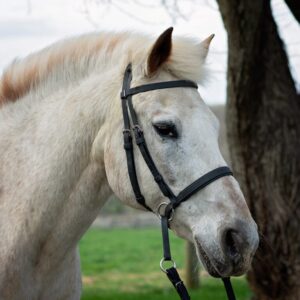
Teddy–AKA Mr. Terrffic
Much to my surprise, I am coming up on the end of my first semester as an aspiring therapeutic riding instructor. I am by no means done with my apprenticeship, but I wasn’t sure I’d make it this far. I’m pausing to reflect and take stock. What have I learned these past few months? Where were my expectations upended, what do I need to focus on going forward to be the best I can at this new undertaking?
My first revelation is that the required lesson plan can be a huge distraction from learning if I allow it to be–and I have. Example: I put together a spiffy little exercise about adjusting the horse’s pace within a gait. Can the rider ask for a faster walk without breaking into the trot? A slower trot without cuing the walk? Very important skill for tuning up communication between horse and rider, ensuring reins are the proper length, and giving the student tools for maintaining safe distances when riding in a group. How wonderfully functioaln this objective is. One might even say elegant, might one not?
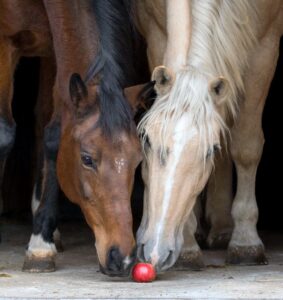 The lesson went along safely and the student seemed to enjoy the time in the saddle. The supervising instructor had to gently point out, though, that the student wanted to use the hour to do more independent riding, and thus the rider was without a horse leader for much of the lesson. The plain evidence right before my very eyes was… my rider was having trouble steering.
But there I was blathering away about exhaling to achieve a downward transition, and congratulating myself on keeping the lesson on track time-wise, while Mr. Very Smart Pony (Teddy) was blowing off his rider’s attempts to keep him from the middle of the arena (the universal rest stop location known to all school horses from time immemorial). Steering is kinda right up there with whoa and go in terms of basic abilities, and rather than focus on that gap in the student’s skill set, I remained determined to execute my brilliant lesson plan.
Note to self: Be more nimble Grace–adjust your pace within the teaching gaits--and pay attention to the student rather than to prioritizing the syllabus.
 The other lesson I’m taking away from round one (so far) is that joy is central to the learning experience. Compulsory education ignores this truth at its peril, but the extra curriculars know it well. Nobody has to learn to play the tuba. No nine year old is required by state law to schlep out to the horse barn in the pouring down rain to work on the posting trot. Both are difficult undertakings full of set backs, frustrations, and plateaus.
The first goal of all my lessons–after safety, safety, and safety–must be providing a positive experience at the barn. If you want to improve every single measure of success at a struggling school, introduce an instrumental music program. Even the students not involved in the program will have better attendance, better grades, and fewer disciplinary incidents. My theory behind that miracle is that music teachers (art teachers, drama teachers…) know  that joy must be on the syllabus, and the world has more tuba virtuosos (and high school graduates generally), and happier school cafeterias because of it.
So in addition to my spiffy, one might even say elegant, lesson plans, I will be bringing my sense of humor, my smiles, my corny jokes, and my love for all things equine to the barn. At Teddy’s suggestion, I also ordered some kazoos.
What teachers do you recall with the most respect and gratitude? What was their superpower?
PS: The audio version of Worth More Than Rubies is now available from the web store!
 We finally had a hard frost, and I got to thinking about why that made me happy. What about this time of year, which most people consider dreary and chilly, gives me a predictable sense of well being?
 Another quality I enjoy about this time of year is that when the sun shines, the daylight is brighter but not hotter. I love big trees and live among them, but once the leaves fall, sunshine comes barreling down from the heavens unimpeded, and my house is actually cheerier for the trees going naked.
 berries?! Not so with the bulbs.
 I have fallen into a pattern of wasting Saturday mornings, and that feels both good and necessary. My schedule has more structure in recent months, in part because I’m pursuing an equestrian teaching credential, and in part because I’m keeping both a romance series and a mystery series moving forward.
 When I start hydroplaning like this, it’s tempting to lecture myself: “Grace, you must focus. Make some lists, my dear. Get organized. Look for efficiencies! Books do not write themselves, the trash will not levitate out the door.”
 Or I might let just one day slip through my fingers. I do fear that one slack day will turn into a hundred, but never before in all my born days has that happened. The probability of banana-peeling my way into an abyss now is not great.
 When I am queen, the US campaign cycle will be shortened to 60 days, period. Our British friends manage to get all contrary and polarized with campaigns conducted in 25 working days (you read that right). They have snarky town halls, divisive memes, public mud-slinging with all the trimmings, and seem mostly content with how their abbreviated campaign window works.
 In that capacity, I have issued a few royal proclamations recently. The first of which says that after listing my five specific gratitudes at the end of the day, I get to listen to three songs. Music is about the best tonic for preserving neuroplasticity, aced out only by the combination of music and dance. Music can elevate mood, reduce blood pressure, reduce heart rate, and boost memory, for starts. So I’m signing off with the good stuff–
 up to nearly a hundred servings. Thanks to my readers, I have that to donate, and really, much of the benefit of generosity lands on the
  So I’m doing what I know to do (in addition to binging the books of the late
  A writer friend who likes to think in archetypes (Mentor, Jester, Warrior, Orphan…) once told me I have a lot of Destroyer energy. This comment was offered as neither insult nor compliment, but simply as an assessment.
 From a writing perspective, the black moment is the point in the story when the identity a protagonist cherished on page one (successful sculptor, happy spinster, brilliant sleuth) lies in ruins at their exhausted, bruised feet. This plot element is necessary so that an even worthier dream and identity can be born in the final pages of the story, and confirm the reader’s hope that the future will be rosy. A good writer has to have a talent for building and destroying fictional dreams.
 But my propensity for firing the figurative photon torpedo has a down side. I am prone to looking for what is wrong, what is in the way of my idea of progress, what is holding back a better reality. I get pig-headed notions and won’t give them up. Sometimes, that junk in the summer kitchen is evidence of a pandemic survived. It needs to sit out there in all its reassuring ugliness for a long time before its job is done.
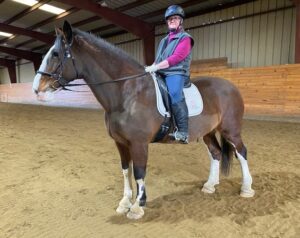 I horseback ride once a week on the dear old steeds at the therapeutic riding barn in a lesson set up just for interested volunteers. This is not enough to get me in any kind of riding shape, but it’s enough to keep my equestrian synapses (and courage) from withering completely away.
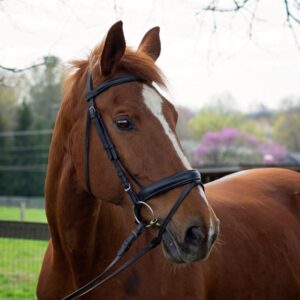 So there’s my barn buddy on Lola, a darling warmblood mare who’s more whoa than go in terms of personality. Ridin’ Buddy had Lola traveling in a nice forward trot circle, and then he asked her for the canter. That mare jumped into the canter and went skipping around like the 17-hand chestnut show girl she used to be. I later learned that my fellow volunteer had not cantered on horseback for twenty years.
 Another moment that goes in the jewelry box is the only time I caught a wave body surfing. I would have been eleven or so, and never before or since have I managed to be in the right place at the right time to feel the ocean lofting me along like a happy porpoise, but I recall the sensation now after more than half a century. Wheeee! is an understatement.
 busy and tense, my daughter’s wedding day was the very day my mom died.
 I operate best in the “almost too busy” zone, meaning I have writing projects, social activities, barn obligations, domestic chores, and various other tasks all rotating through my day. When I hit the balance right, I feel productive, satisfied, challenged, and fulfilled.
 Another impulse when I’m slammed is to do everything (or make little rules exhorting myself to do everything). Do one housekeeping project every day, bring the general ledger up to date, walk a thousand steps every hour–it only takes ten minutes after all–and move some money into savings because that will somehow give Lord Julian the big insight to solve the next mystery. Just do enough stuff and surely calm will eventually return?
 Nope, not that either.
 In other words, when I am tempted to speed up, work faster, and discard time for reflection and self care., that is precisely when I need to slow down, work more strategically, and prioritize breathing room and support. And of course, at the end of every one of these slammed, daunting days, I make time to read a good book, and then–having done the best I could with the day, and having cosseted my heart and mind with a good yarn–I turn out the light and am grateful that tomorrow, I can give it all another shot, starting with: Write one scene.
 I have been watching a friend struggle with chronic illness for the past several years. Her medical history was daunting before I met her, but as with most chronic health problems, the passage of time has seen further deterioration and complication in her situation.
 When I think about how did we get here, the answer is simple: We decided that efficient medicine (profitable medicine) was good medicine. We decided that education that meets external objectives was good education. We decided that monetized productivity is a cardinal virtue. I cannot tell you how many apps and programs out there purportedly help authors write books faster and more efficiently.
 Were all those thousands of words I wrote any good? Did I graduate “successfully” from high school with no friends and a lifelong aversion to reading? Is my company bodaciously profitable only because its policies and products are dishonorably designed and created (looking at you, ChatGPT)? As long as we’re looking at “data,” and “bottom lines,” and “objective numbers” for our sense of a situation, we are distracted from the uh-oh feeling, the sheer joy of a beautifully written scene no matter how short, or the harm done when we teach the curriculum instead of the child.
 Measured outcomes pull us away from our internal experience of a situation and yank us into emphasizing an external assessment of what we’re dealing with. That’s how our brains work. If we see that a YouTube video we loved has earned mostly a thumbs down score from previous viewers, we are less likely to give it a thumbs up. Our experience loses validity in the face of “what the numbers say,” even though we know those numbers are probably, even purposely, polluted by trolls and bots.
 How are you doin’ just fine despite any numbers to the contrary? Where in your life do you enjoy an abundance of some unquantifiable wonderfulness? I am wealthy in unstructured time, solitude, quiet, health, access to books I enjoy, meaningful relationships, animal friends… I’m such a tycoon, despite the numbers!
 I have been thinking lately about how we cope with adversity, especially the open-ended, no-clear answers kind. Then I found myself a guest in my sister’s house, which is small and lovely. Every wall has art on it that is meaningful to her, every room is arranged to maximize light, comfort, and simplicity. The colors soothe and please, the textures are interesting and varied.
 English class was a safe place. I would have had to work quite hard to get anything but an A in junior high English class.
 Authors are exhorted in workshop after workshop to ensure that in every scene, the main character has a goal. The character must be moving toward some objective, whether it’s to consummate wedding vows, find a particular library book, or overtake the villain’s carriage. Similarly, people approaching retirement are instructed to retire to something, not just from a job.
 I tend not to set overt goals. I did not look around my writing life on a conscious level, and think, “Well, the published author thing continues to delight, but the artificial intelligence barbarians are at the gate, the pirates steal every book the day it comes out (with the affirmative support of the very wealthy AI barbarians), and the subscription model interposes powerful corporate money-suckers between author and reader–money suckers far greedier than any traditional publisher has been with me. Might have to build a fall-back plan for when relevance as an author has been obliterated.”
 That kind of decision is typical of me. I don’t make plans or do annual reviews or read the market in any conscious process. I think about stuff, and ponder, and question (“Why not take a look? Drop in for a session? Do a trial run?”), and then those small, noncommittal actions move me off in a specific direction. If the baby steps go well, the steps get bigger, and so on. One of the reasons I decided to try the weight loss drugs was because the apparent mandatory step–one shot a week, quit whenever you feel like it–was so small. No commitment, no publicity. Just a little experiment.
 What are you moving toward or away from? Are you a goal setter or more like me–a wander in that interesting direction and see where you end up-er?