





Keepers

When the economy tanked, my personal finances followed suit. Winter of 2009 approached, and I was digging the spare change out of the couch cushions, Coinstar-ring the grocery runs, and rationing shampoo. Bills were paid at the last minute, if not late, and I was reminded of my dad’s philosophy for forestalling unneeded acquisition: Can I do without? Can I use something else? Can I fix what I’ve got? If yes to any of the foregoing, don’t buy it.
We’ve all been there, many of us dwell there regularly. I wasn’t quite terrified—I have family and friends—but I was, shall we say, anxious. Very anxious.

Also too broke to buy books.

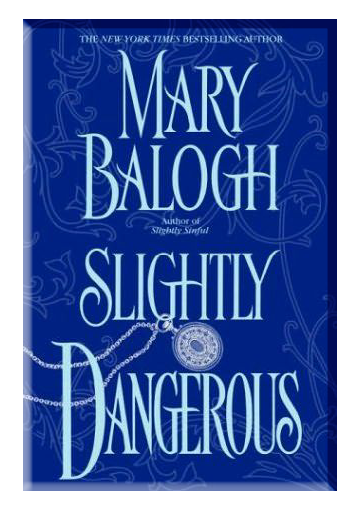
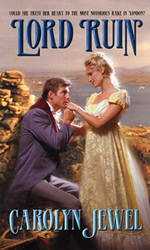
Off to my keeper shelf I did go: Mary Balogh’s entire Slightly series, start to finish came first, then my wonderful Judith Ivory collection. From there I mined my very favorite Loretta Chase titles, my Julie Anne Long’s, and whatever I had on hand from Jo Bourne, Sherry Thomas, Meredith Duran and Carolyn Jewel.
This was… bliss. A reunion of old friends, and a recollection of all the times in my life when I’ve turned to books for solace and fortification. One of my all time favorites is Loretta Chase’s “Not Quite A Lady,” which is not a big book, but it’s a book with a big heart.

“Not Quite A Lady” has a simple premise: A marquis’ daughter who managed to deliver a secret baby at age sixteen has made a career out of discouraging the attentions of appropriate men, lest any of them learn of her lapse. When Darius Carsington moves in next door, Charlotte is equally attracted to and exasperated by him, wanting very much the passion he offers, but unable to trust him to protect her confidences…

Darius is a hyper-rational natural scientist who views reproductive urges as so much biology, until Charlotte’s courage and vulnerability engender feelings he eventually admits are worthy of the label, “attached.” And once he falls, Darius becomes Charlotte’s champion in all things, even to healing the loss she endured years earlier.

The book is tender, humorous, steamy, and fast paced. I find something new to admire about it every time I read it.

And that was just one of the old friends I found on my keeper shelf. I’ve decided the word “keeper” does not refer to my maintaining ownership of favorite books. The term refers to the books that have kept me sane, coping, hoping, and functioning at times in my life when all temptation was to the contrary.
I have keeper poems, keeper songs, and keeper movies, but late at night when the moon is full and the thermostat turned way down, it’s my keeper books I’ll reach for to keep my heart warm.

What about you? What’s the book that never fails to cheer you along, to provide consolation in the tough times, and new pleasures in each reading?

To three commenters, I’ll send copies of “Not Quite A Lady,” and please recall that if you left a comment on my blog about Sarge a couple weeks ago, I’ll send you a copy of “The Bridegroom Wore Plaid,” if you’ll send me your snail mail addy.

 

Making a List…

Some weeks it’s hard to know what to blog about. My life is prosaic, and I value my privacy, and what, in the territory between those two realities, is worth sharing? Then I see somebody else dart forward with a simple, worthy why-didn’t-I-think-of-that idea, and I know for one week, if I’m willing to indulge in a bit of attribution, I’ve found my topic.

Author Vicky Dreiling writes a fun, warm hearted, Regency romance, and has many, many accolades to show for her efforts. She’s also one heck of a nice lady, and came out with a Facebook post this week along the lines of: Thanksgiving is coming. I’m posting one thing I’m grateful for every day this month.

Brilliant! And when wouldn’t that be a good idea?

So with a tip of the quill pen to Vicki, here’s a short list of things I’m grateful for, in no particular order:

1)      Loving family of every description, including friends and pets, also strangers who help when they see the need

2)      Health, enough health to (mostly) do for myself

3)      A life where at least for today, the necessities are tended to: Food, clothing, shelter

4)      Literacy and all that flows from it

5)      The arts—music especially, but the visual and plastic arts too

6)      A niche in the legal profession where I can be helpful to those disempowered by circumstances beyond their control

7)      The green growing things, whether we use them for food, just for pretty, or to keep us supplied with oxygen

8)      Weather. For reasons I don’t understand, I need the variability of weather and season to keep me moving forward

9)      Imagination, for when all my blessings don’t feel like enough, and I need to grasp an image of happiness that’s not yet realized

10)  You. You read my words, and that helps give my life a bit of its meaning. Last week’s posts about our pets reminded me of this emphatically. I’m grateful for you.

Your turn! To one commenter, I’ll send along a signed Advanced Reader Copy of “Lady Eve’s Indiscretion.”

Sergeant Preston of the Yukon to the Rescue

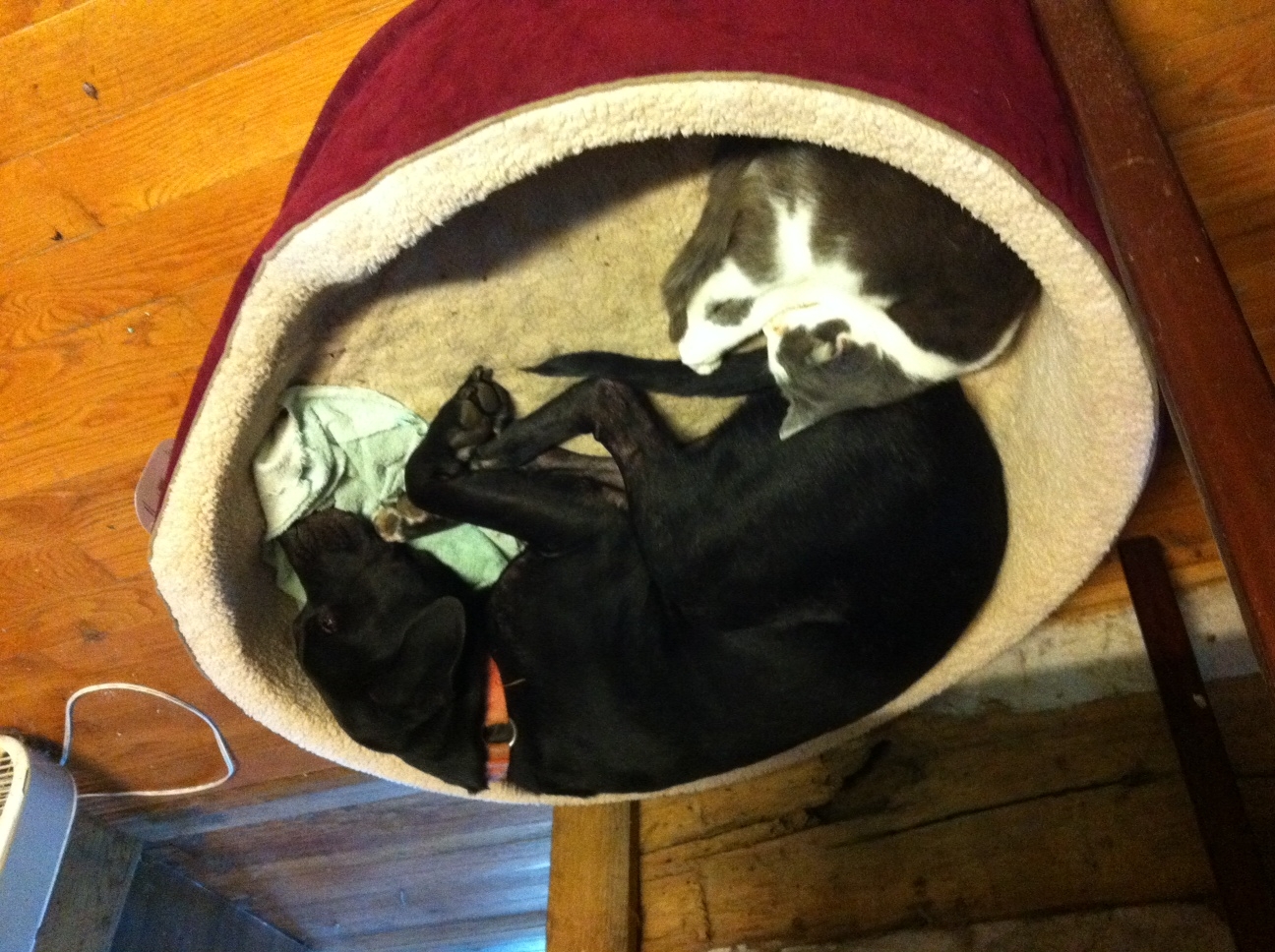
My mastiff lived far longer than his breed is supposed to, but my bull mastiff out lasted him by even yet a few more years. To keep the bullmastiff company, I betook myself to the pound, and asked for the biggest, oldest, black dog they had.

People tend not to adopt big dogs, old dogs, or black dogs, and the selection was daunting. The long term inmates included a lot of grinning Rotties, a few shepherd-cross looking beasties, and one fellow who looked kinda like a Lab-Rottie cross. Amid all the “Pick me!” and “Hey lady, over here!” commotion, that one dog lay quietly watching me was I went from cage to cage.

Sarge and Teapot

The quiet dog had dignity, and this is a virtue by my lights. I read his card—he knew some commands, didn’t bark much, and answered to the name of “Sarge.” What’s not to like?

“You,” I said. “You’re coming with me.”

Sarge and Boo Boo got along well enough, though it wasn’t long before Boo Boo followed Fuzzy up to the Cloud Pasture. This left me with a dog, when I’m not a dog person.

If I leave Sarge home in the morning, his expression is sad, a touch reproachful, and resigned. Despite how deeply I disappoint him, when I arrive home hours later, he’s ecstatic to see me. (Boyfriends, husbands, children, take note.)

While it’s nice to come home to a cheerful reception, it’s also nice to have company at the office so Sarge has become an officio member of the bar. I sit at my desk doing lawyer stuff, talking on the phone, reading my files, and yet a little bit of me is also aware that Sarge is peacefully napping a few feet away.

Of course, a dog must have regular outings. When we’re at the office, I will take him boulevardiering at mid-day, even if it’s a court day. Ours is a quaint, old-fashioned section of town. While the block is defined by streets on all four sides, alleys criss-cross behind buildings, and many carriage houses and stables line those alleys.

Sarge inspects every vacant lot on our block, sniffs every little sprig of lambs quarters growing around every telephone pole or lamp post. When we walk past the soup kitchen next door, he must make six new friends among the people waiting in line for their lunch. Without fail, if somebody sees this black mutt on end of my horse lead rope (a nice, lavender colored one), they start smiling.

We also sniff our way past the old folks’ assisted living apartments, and on the benches outside, Sarge finds more friends. He’s an equal opportunity smile-generator, happy to kiss strange old men, delighted with the attentions of the smokers we find on various stoops. Doesn’t matter who you are, if you can pat a dog, Sarge is your buddy.

He asks very little of me, this dog—some puppy chow, the occasional visit to the vet so we comply with the county’s laws about vaccines and licenses. Mostly, Sarge wants to know where I am, and to be with me.

I am not a dog person, but I am a Sarge person. He asks little, gives much, never complains, and sets a good example for me in terms of his unfailing good cheer, and his nonjudgmental view of everybody he meets. If I only say “I love you,” once in the course of my day, I could do far, far worse than to say it to this dark, handsome fellow who has become my domestic companion.

What about you? Has your path ever crossed that of a good example on four legs? To one commenter, I’ll send a copy of Richard Armitage reading the Georgette Heyer classic, “A Marriage of Convenience.”

Contested Winnings

We come now to the time of year I think of as “contest time,” meaning the time of year when chapters of Romance Writers of America are holding writing contests for aspiring authors. Some of these competitions are fierce, with as many as 300 entries in a single category, and all of them take tremendous effort to coordinate.

I am published in part because of these chapter contests, for two reasons. First, when my prospective editor asked, ‘What ammunition can you give me to set you apart from all the other unpublished Regency authors?’ I could point to a fistful of contest wins and finals. I had no idea they were significant, but they got me the all important boost out of the slush pile.

Second, many contests are judged by published authors, and friends and neighbors, I am telling you, when a published author sets out to ‘splain what you’re doing wrong, she’s usually accurate, articulate, and ferociously determined to get her message across.

I got comments along the lines of, “I’m being so hard on you because I believe in your voice.” That after, three pages of solid, relentless critique. Another author told me I was going to end up in the missed-it-by-that-much category if I didn’t tend to the things she pointed out, and that would be TRAGIC, given the potential in my writing.

Yikes! I paid attention. I buffed the goods and now it’s my turn to judge a few contests.

I enjoy it. I enjoy seeing the wonderful creativity awaiting publication, I enjoy knowing I might be able to sand off a few rough edges on somebody’s writing, and give them the boost so generously given to me. The world can never have enough well written love stories, after all.

And that would be motivation enough to accept the judging packet, but a funny thing happens when I get into judging mode: My writing improves.

When I’m beavering away at a Work In Progress, I’m usually struggling to get the story on the page, struggling to figure out what the story is, so I can get it on the page. I lose sight of the old chestnuts:

1)      Avoid starting a sentence with ‘there are,’ or ‘it is’

2)      Cut the words, ‘just,’ ‘very,’ and ‘that’ whenever you can

3)      Establish the setting with sensory details that are either symbolic or have significance to the Point of View character only

The list of shoulds and oughts is long, and as Voltaire observed, when it comes to writing, the list cannot be learned quickly no matter how talented or dedicated the student. I’m reminded though, of the efficacy of the one room school house approach to education.

Once upon a time, somebody took a bunch of students from a public school setting, and instead of having each grade taught by a separate teacher, they went back to the older method, of having the students in each grade teach the students below them in one-to-one or nearly one-to-one sessions. The result was an improvement in everybody’s performance, and with much less effort on the teacher’s part (though I assume the process took more time, at least).

So I get to help out some aspiring writers, but I benefit as much as anybody else. Pretty cool.

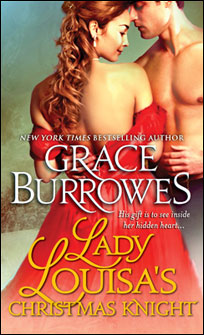
Has a generous impulse ever yielded an unexpected bonus for you? To one commenter, I’ll send a signed copy of “Lady Louisa’s Christmas Knight,” or, if you’re an aspiring author, I’ll critique three scenes of your fiction writing–let me know in the comments if that’s your preference.


Happily Ever Grateful

“It will never hurt your career to help another author.” Julia Quinn included this admonition in a recent speech to a group of romance writers, myself included. She had other gems to impart, but this one stood out to me and garnered immediate applause.

I haven’t been writing that long, but I’m confident of my facts when I say there is an ethic—not just a habit, not a tendency, but an ethic—among romance writers of mutual support. When I go to writers’ workshops, I hear the science fiction/mystery/thriller/literary writers complimenting the romance writers on the extent to which we encourage each other, share what we know, and go a long, long way to get each other published.

This attitude of shared endeavor was an enormous surprise to me when I started writing. I’m a lawyer, and maybe that predisposes me to adversariness. I’m also used to figuring things out for myself, relying on myself, and generally making my own way—and those characteristics were present before I studied law (says my mother).

So when a book of mine hits the shelves, and somebody emails me offering to give me a guest slot on their blog, I’m surprised and thankful.

When I sit down at a signing, and the authors on either side of me immediately introduce themselves and admire my book covers, I feel bashful.

When readers shoot me “enjoyed your book/keep ‘em coming!” emails, I am shamelessly flattered that they’d take the time to appreciate something they paid hard earned coin to own.

When my editor spontaneously gathers up all her authors for a meal at a conference, and gives us a chance to hear from one another about what we’re working on, I forget the food on my plate.

Having my books for sale is encouraging for somebody who does not view another twenty years in the courtroom with boundless glee, but being in a healthy community of writers is… well, it ought to be the last item in one of those credit card ads, the one described as priceless. People pay money to spend time in groups where they’re listened to, encouraged, mentored, made welcome, and supported. Short of family and the occasional church group, that kind of interaction is rare and precious.

All of which is to say, I’m grateful to write romance novels. In the greater world, and the literary world in particular, romance novels are not considered a significant contribution. Our readers feel differently, because, as Julia Quinn also said, “we make people happy, and that matters.”

I’m proud to associate with the people I know who write romance. The overwhelming majority of them are generous, courageous, kind and honorable. Maybe it’s because we believe in the love we write about, maybe it’s because writing is a fundamentally humanizing pursuit.

I don’t know why I’m privileged to associate with such a group, but I’m profoundly grateful to call myself one of them.

What about you? What was your first experience with being part of a group you were proud of and grateful to?

To one commenter below, I’ll send a signed copy of “Lady Louisa’s Christmas Knight.”

Merry Christmas!!!

This week marks the launch of Lady Louisa’s Christmas Knight, the tale of Louisa Windham and her doting, growling, limping, pig-farming swain, Sir Joseph Carrington. Louisa doesn’t see those qualities in Joseph, though. She sees that he listens to her, he asks her to dance when nobody else has the courage, he recites poetry to her, and he risks his life to save her reputation. Guess what Louisa gets for Christmas?

And Joseph? He doesn’t see that Louisa is too smart for her own good, nor that she lacks the preferred pale English beauty, nor that she suffers a lack of small talk and flirtation. He sees that she’s brilliant, lonely, brave, loyal, and completely going to waste in the ballrooms and conservatories of Mayfair. How anybody could overlook such a treasure baffles him utterly.

Michael Hague, a noted teacher in the field of screen writing and story architecture, has a pet peeve with many romances: On page 3, the hero and heroine see each other across a moonlit alley/crowded ballroom/soccer field or battle field, and fall in love: THUNK! He or she is emotionally distant, despite there being Chemistry. They snark at each other, sabotage each others’ plans, and so forth for 300 pages, but on the strength of their mysterious attraction, they cast Steamy Glances (ahem) at one another anyway.

His point is that if you or I came across such a potential mate, we’d perhaps indulge in a fling, but never consider them keeper material. What creates a credible bond is when somebody GETS us, they understand when our wounds are acting up, and their response is compassionate. They appreciate our strengths even when those strengths are standing between us and our best selves. They do not love us and leave us, or toss grenades at our dreams.

And maybe this is why I love Louisa and Joseph as a couple. More than other couples I’ve written, these two complete each other. They are not a crooked pot and a crooked lid, they are the pot and lid made for each other in a unique and beautiful design not intended for the standard kitchen. Last year, they were my Christmas present. This year, I hope they number among yours.

So… in the interests of making our Christmas shopping lists, who are some of your favorite romantic couples, and are there any romantic leads who just did not work for you? To three commenters, I’ll be passing along signed copies of Lady Louisa’s Christmas Knight.

The All Important Mirror

WHY have I gone two weeks without updating my blog? Shame on me! But not really shame on me because I was off at a writing seminar taught by James Scott Bell. I want to learn how to write really good books, you see, and that means I must occasionally tear myself away from the fun of writing and focus on the craft of writing.

And friends, I learned a lot. One of the concepts cited frequently was that of “sign post scenes.” These are the moments that recur, book after book, in much good fiction. Many writing instructors have a of list of them, or particular names for them–the inciting incident (JSB does not like term because every incident in a good book ought to incite somebody to do something, right?), the black moment, the point of no return.

I’m not much of a list maker, not much of a conscious book plotter, but one scene we discussed stood out: The Look in the Mirror. This is the point in the book where Our Hero and/or Heroine is barreling along, trying to mind their own business or save the world or stay drunk, when the Clever Author puts them in a situation where they must face what sort of person they’re becoming (or have become). They further face the fact that they have choices regarding whether that’s the sort of person they continue to be.

Interestingly, Mr. Bell noted that this scene is often dead center in the book. Michael Hague of Storymastery legend says what he finds at the dead center of the book is a scene he calls, “the point of no return.” By that point, the protagonist has gained enough insight to know the old self or life is lost to them forever, but they haven’t quite located the courage to commit to change.

And I’m sure every half-awake romance reader in the room is noting that around page 175 is usually when the relationship is fully consummated. This makes sense to me. What is an intimate moment, except a time when we’re forced to deal with who we are, who we really, truly, probably not entirely happily are?

And yet, I don’t think one scene of a character peering into the moral mirror will do for a solid romance. From my perspective, the function of the entire budding relationship is to give the character the courage and motivation to deal with their wounds, weaknesses, and flaws, and  step by step, to change themselves if necessary to earn a life graced with  true love.

What do YOU think? Have the books you’ve enjoyed had a light bulb scene in the middle of the book, or shown character growth over a progression of scenes? Both? Neither? Does any of this relate to real life?

To one commenter, I will give a SIGNED copy of Eloisa James’ lovely, “The Ugly Duchess,” which has a lot to tell us about change, growth, and true love.


She Who Hesitates

While waiting for my mom to get ready for a trip to the grocery store, I passed the time by perusing the San Diego Union Times. I saw an article go by that described a book touting the idea that in addition to everything else our hurry-up, go-go, do-do lifestyle is costing us, it’s also tempting us into more and more stupid decisions.

I regret I cannot recall the name of the book, but it purported to be a well supported, scientific case for the idea that the best decisions are the ones made with the greatest deliberation, just short of waiting too long. This flies in the face of much that we hear:

Go with your gut.

Your first choice is usually correct.

He who hesitates is lost.

Just do it.

By contrast, the author pointed out something I think should be obvious to everybody who’s ever started doing the homework assignment before the teacher finished explaining it (only to find when they get their grade that they did it wrong): Good decisions are made based on good information. Ergo, the longer you sit with a choice, gathering data about the options, pluses and minuses and your reactions to them, the more likely you are to make a good decision for you.

My editor may be on to the same reasoning, because she has challenged me with my next book (about Sebastian and Milly, whom you haven’t met and I’m just getting to know), to up my craft. Madam Editor says to take my time, to nibble and nosh my way through this book, not set the world on fire with a land speed record.

The result so far (about ten percent done), is a process I’m enjoying very much. I made myself figure out the entire general plot before I worked on the opening scene (thank you, Kansas). I don’t start a scene until I know what makes it an “uncuttable” addition to the book. When I write the scene, I’m mindful to put that uncuttable aspect as close to the end of the scene as I can, and I’m trying to make the writing vivid, precise and wracked with tension.

This is fun. Instead of telling myself, “If I average 3000 words a day, I can finish a draft in a month,” I’m telling myself, “It’s not done until you say it’s done, so take your time, and write the heck out of it.”

We’ll see if I can sustain this approach for an entire book, and what the results are. My next step is to figure out what about impulsive decisionmaking is so attractive, and how I can slow the process down to improve its results.

Do you have any rules of thumb regarding decisions? Do you wait twenty-four hours if it involves money? Always consult your spouse if it’s kid-related? Put off until tomorrow if you can?

To one commenter below, I’ll send a signed copy of the Advanced Reader Copy for “The Bridegroom Wore Plaid,” or the Grace Burrowes book of their choice.

My Favorite Line

I have a lot of favorite books. As a kid, I loved the Uncle Wiggly series, mostly because my dad read it to us at bedtime, and seemed to enjoy the Skillery-skallery Alligator more even than my brothers did. Dad also referred to my mom, a registered nurse, as Nurse Jane Fuzzy-Wuzzy, which probably endeared the series to us further.

I adore certain passages of the Bible as translated in the King James version. Regardless of any theological inclinations, this is gorgeous, vintage English employed in the expression of some beautiful sentiments.

In first grade, I read about Dick, Jane and Sally (though I always wanted more stories for Spot and Puff), and was soon reading every horse story the school library contained. I quickly moved on to anything Hardy Boys, some Bobsey Twins, and a smattering of biographies.

Then, in third grade, we had a story hour one day over in Mrs. Sofranko’s room, and that is when I learned the meaning a “favorite” book. Mrs. Delores Sofranko was cool. She’d done a Peace Corps year in Nigeria, she was pretty, and she had a smile that said every child she ever met was a wonder to her. The lady could teach.

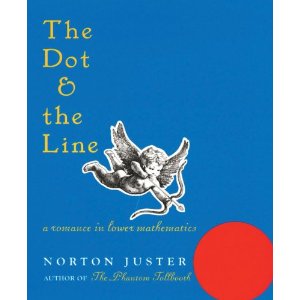
The book she chose to read to us that day was simple, not even a chapter book, though her audience had reached the venerable and smug age of eight. I mean, this was a children’s book, but I gobbled up every word of, “The Dot and the Line.”

A tall, dark, relentlessly straight Line, falls in love with a carefree, happy-go-lucky Dot. She thinks he’s serious, dull and not worth a second look—the mad Squiggle is ever so much more fun— until the Line realizes he can… bend. With some effort and imagination, the line bends to form an angle, and then he contorts himself into increasingly fascinating geometric shapes. As the book progresses, so does the romance, until at the end, the Dot and the Line realize they can live happily ever after.

Put them together as illustrator and author Norton Juster did at the end of the tale, and you get an exclamation point! In the movie version (there was one), the tagline is: To the vector go the spoils.

The subtitle for the book is, “A Romance in Lower Mathematics.” I loved it. When we were given an art assignment to draw a scene from the book, I drew the Dot and the Line eating popcorn on a park bench. They didn’t quite sit next to each other, so we know the scene was from the first half of the book—right?

I loved the cleverness of the book, the utter impossibility of two such different characters finding a way to be together. I loved that the Dot had to realize that the Squiggle was silly and disorganized, while the Line had find the courage for self-expression and creativity. These characters had arcs, they had to risk changing their self-concepts, and they found their Happily Ever After.

When Jo Bourne won her RITA for the Best Historical Romance of 2011, she used her moment at the microphone to thank her teachers. I didn’t start writing romances until I was in my late forties, but my enthusiasm for the genre traces back to that day 45 years ago, when I heard an inspired teacher read a simple book, “The Dot and the Line.”

 What’s the first book that stuck with you? Any idea what made it so memorable? To one commenter, I’ll send a Toby Stephens version of the “Jane Eyre” DVD.

Justice Might Also Be Deaf

Driving around the Central Valley of California, I got an insight.

I did not want an insight, I wanted an external conflict in my next book. I’m always in need of those, always in need of practical, believable stubborn problems to visit on my protagonists, problems that will drive them apart and bring them together, both. When I come up with one, you’ll hear about it because I’ll be happily reporting progress on some book or other.

The insight that befell me has to do with why the courtroom has become an increasingly difficult place to earn my living. Part of the trouble is that my jurisdiction is laboring under the same budget difficulties as the rest of the planet, so child welfare cases aren’t coming to court until things are dire, indeed.

Much like a health care system that doesn’t emphasize prevention, the challenge of making a meaningful difference for a family in trouble gets tougher, the longer that intervention is denied them. I’ve dealt with some really crappy cases this year, one after another, and that’s hard.

Everybody else involved—the social workers, judges, opposing counsel, therapists, psychiatrists and so forth—are all stressed by the same factor, and that’s hard too.

I think what’s most difficult, though, is that the court room is a place where everybody but the judge is allowed to not listen to each other. Each party is concerned only with putting their version of the facts before the judge, each lawyer wants only to make the most convincing closing argument—myself included, on a bad day.

If we listen to one another at all, it’s to better plan our rebuttals, objections, and cross examinations. We’re not listening to understand, we’re listening for strategic advantage.

This is a chancy way to solve complicated problems. It gives the judge not varying versions of the truth to work from, but varying self-interested perversions of the truth.

In a love story, part of the character arc for the protags is to learn to hear each other, despite all the temptations and self-interest to the contrary. The result is a happily ever after, for two reasons. First, only by hearing each other can the parties work together to safeguard the child, find the missing document, or otherwise defeat their problems.

The second reason a happily ever after results is that a person who’s intent on listening for understanding is a person who has admitted to a hope—a difficult, vulnerable thing, to hope—that a mutually agreeable solution exists. Somebody who listens is mature and secure enough to set their own agenda aside for at least a few minutes, to elevate a human connection above the need to win

Those are the people who earn happily ever afters. I haven’t found too many of them in courtrooms.

If you were going to write a romance about a lawyer, what problem would you give him or her to solve on the way to their HEA? To one person who comments, I’ll send a $25 Barnes and Noble gift card.