






 As an undergraduate at Penn State, I became involved with the campus newspaper, The Daily Collegian. Our newsroom was housed in the Carnegie Building, a venerable old relic from the early 1900s. I never gave much thought to the building’s name, figured it had something to do with Andrew Carnegie, who was a Rich Guy who lived Back When.
I did know that Carnegie Building had been the university’s first free-standing library building, and it seemed appropriate that the School of Communications should inherit Carnegie Building (the largest school of communications in the country, who knew?).
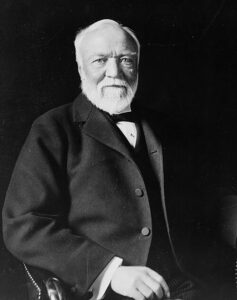 Fast forward a few decades and I’ve just finished a biography of Andrew Carnegie, who was, in his day… the richest man in the world, richer by far than the oligarchs we have underfoot these days. He was the son of a Scottish weaver put out of work by technical advances in loom design. The family emigrated to Pittsburgh in 1848, where they had friends and relatives already established in the United States.
Carnegie rose to great wealth through a combination of luck (tons and tons of luck), charm, genuine business smarts, and sheer ruthlessness. His schtick was making steel, and he happened into that business at a time when America was building infrastructure at a phenomenal rate. Railways, bridges, skyscrapers, military vessels… all required tons and tons of steel, and Carnegie cornered the market, largely because eastern European immigrants were willing to work under hideous conditions rather than starve. Then too, he benefited enormously from protectionist tariffs levied to keep the American steel industry from having to compete with established suppliers overseas.
The Sherman Anti-trust Act owes much to men like Carnegie who colluded endlessly to enrich themselves and one another at the expense of their employees and customers.
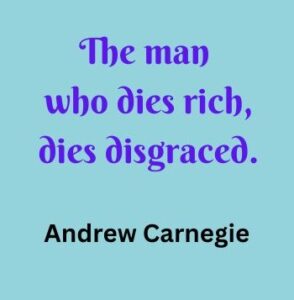 But at the age of thirty-seven, Carnegie stepped away from active business. He turned over his companies to managers, he started looking for a buyer for what would become his U.S. Steel stock (John Pierpont Morgan took the bait many years later), and he began giving away enormous sums of money. He made it his public mission to give away staggering sums, funding all manner of public and academic libraries, technical schools, university posts, museums, and “Hero Funds,” to support the survivors of those who’d lost their lives trying to save others.
He also became an outspoken and tireless advocate for peace, using his social stature to presume on six different presidents more or less at will. He became an object of ridicule in old age, because men like Teddy Roosevelt regarded peace advocacy as so much impractical ranting from clueless dreamers. This did not stop Roosevelt from asking Carnegie for huge sums to fund a year long big game “research” hunt, and Carnegie came through.
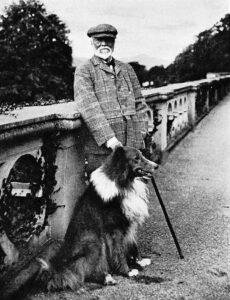 This book did not sit well with me, in part because Carnegie was so contradictory. Maybe fiction writing and reading–or the news trying to impersonate entertainment?– has conditioned me to look for characters who fit into simple functional roles–protagonist, sidekick, mentor, antagonist. But I was also struck by the fact that this one small man (5 foot 3) was worth much more than any of our present day oligarchs in constant dollars, and he chose to use his wealth to found more than 1700 libraries in North America alone. One of his charitable foundations was responsible for the grant that resulted in Sesame Street and the Children’s Television Workshop.
His influence is nigh incalculable, as both a philanthropist, and as an example of a capitalist who could justify taking lives (ten workers were killed when strikebreakers were brought in to the Homestead Mill) for the sake of… money?
 In any case, I found Carnegie’s tale important both for the good he did and the evil he perpetrated, but his story isn’t well known. If we included his Gospel of Wealth in our economics curricula (essentially, Rabbie Burns socialism under the guise of noblesse oblige), would we be where we are? Would we be in a worse place yet?
The book made me think and question some of my assumptions, and that’s a good thing. What important life stories have you come across that either inspired or troubled you?
PS: Look who finally got a cover!
 I have plowed my way into what I call a compression phase, when the to-do’s pile up, the unforeseen must-do’s crowd in, and it’s an especially good idea (and hard) to stay organized. I knew I was ramping up efforts in the certified therapeutic riding instructor direction, and I knew I had teaching-how-to-write gigs in early April and late May. (I am not at all sure how I ended up with book releases back to back in
  All of which is to say, things are busy, and except for the bug I caught, busy in a pretty good way. I’m doing the stuff I love to do (writing first thing most days; the occasional lunch with writing, horsing, or life buddies; ending each day with good reading). The yard work is something I used to do and can enjoy again, now that I have the right tools. The instructor certification process has taught me a lot and put me in the company of wonderful horses and great people.
 Stuff like: Linger in the shower for an extra couple minutes. Pick a bouquet of yard flowers for the bathroom. Have one of those cups of tea just sitting on the porch steps talking to the cats. Stop at the battlefield overlook on your way home from lunch and just breathe for a few minutes. Post something that encourages another writer (because when we are kind, WE feel empowered, and well we should).
 To earn the therapeutic riding instructor certification I’m pursuing takes a lot of steps. One requirement is for volunteer hours at a certified therapeutic riding facility, another is student teaching hours. You must also spend time demonstrating your knowledge of horse care for both well and unwell horses. A first aid certification figures early in the process as does a test of professional standards applicable to the discipline.
 Blah, blah, blah, and the video cannot be edited in any manner. You either nail this video, or you are denied permission to take the final tests. No pressure.
 I felt kinda slapped up side the head. He was thinking of thank yous, I was thinking of my next heartfelt bellyache. At another point in our discussions, he mentioned that he’d bought a bottle of champagne to open when he completed all of his pre-final test requirements.
 I forget where I came across this idea, but it has been on my mind lately: We are wired to value what we suffer for. This aspect of human psychology is at least in part behind hazing, boot camp, most fitness programs, freshman weeder courses, and the practice of sending young people on evangelical missions. If you spend 18-24 months having doors slammed in your face, living on a shoestring, homesick, and subjected to rigid social strictures, you are set up to conclude that the inspiration for all those miseries must be a pretty worthy part of life.
 In my life, I can certainly see the “if I’m suffering for this cause, it must be worthy” mechanism at work in parenting. Nothing wrung me out emotionally, physically, or financially, like being a single mom. I don’t think I have another slog like that in me, not for any motivation on this earth… except maybe my grand kids? I got caught up in the same rip tide, though, with child welfare lawyering.
 What has been puzzling me lately is that this dynamic–if I’m suffering for it, it must be a worthy relationship/institution/cause–typically pops up in precisely the areas where maintaining some objective judgment, or keeping a healthy boundary, is particularly important. We suffer for family, for the company that employs us, for the church that never seems to have enough volunteers or money, no matter what its bank balance is or how many seemingly not-so-busy people attend services.
 I know the pandemic is truly in the rear view mirror because writers are starting to get together for conferences again. Not the monster cons of yore, which only about twenty venues in the whole country could accommodate, but nice little get togethers at the retreat or single-hotel level.
 Regency history. We talked and talked, about the parallels between the Regency’s notorious
  American life in general, are good places to pass the time with strangers. Six days a week, most of us either work or worship with the same people. Americans also don’t have a “local,” a watering hole that’s part club part hideout.
 Welp, I did not get those energizer bunny genes. I (and I alone in my family) got the genes that make me a champion sitter-downer. Younger authors ask me the secret to my productivity and I want to say to them, “I have a natural capacity for physical sloth.” It helps that I like words too, though truly, my mother could not have endured the amount of sitting I do to get a book written.
 So I have to be cagey about coaxing myself out of my writing chair. “C’mon, Grace. You just wrote a great rough draft of a scene. Lunch time has come and gone. Time to go for a toddle!”
 “You did it. You got up and boogied, and this is wonderful of you. But you know, it’s only a couple more telephone poles to the bottom of the hill, and it is downhill, and there’s no headwind. Why not just do a couple more telephone poles?”
 My property is bounded on two sides by good old farm country hedgerows. These innocuous looking strips of trees and bushes want you to think they will mind their own business, century after century, but that’s a flaming falsehood. Hedgerows are after world domination. Just leave one unattended for two years, and you’ll see the evidence.
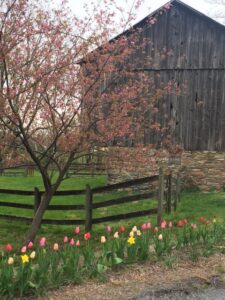 Yard guy quotes me big thousands to a) remove 270 feet of still-functional three-board oak fence and haul it away, b) bring in huge tree-eating equipment and reduce all unwanted specimens to sawdust (while alas, also killing my two baby apple trees), and c) rebuilding the fence with new materials.
 I read the power saw manual (with a magnifying glass), fired up the saw, and got to work. Within about twenty minutes, I was thinking maybe I could manage a larger saw. I have repulsed the invading saplings, cut the poison ivy off at that roots, freed the fence of dropped branches, and generally given the hedgerow’s nefarious aspirations a middle finger. And when a tree dropped on the fence this week, I called the guy who tills my garden, and he knew a guy who knew a guy, and the mess was cleaned up for a modest price the next afternoon.
 I did not much grieve the closing of my law practice. The law wasn’t my first career (the piano holds that honor), and I had the happy prospect of writing more books to keep my focus forward. Then too, I had a trip to Australia and New Zealand planned for my first month free of the courtroom, and holy Ned, was that a wonderful excursion.
 Then I had to have a back tooth pulled. When my four impacted wisdom teeth came out, that was just a weekend spent in the company of Tylenol and old movies. The most recent extraction was… you’d have thought I was losing some typing fingers, not a part of me that’s honestly expendable and invisible to others. The problem, I came to believe, was the sense that my molar was a harbinger of the Great Decline–a harbinger I could not minimize, ignore, or rationalize away. This upset me.
 When I cannot hear what a riding instructor says in the arena, I must consider that the problem is not that she’s ten yards off and facing away from me while my saddle squeaks and the horse thumps along, but rather, that I’m losing my hearing. My mom did, (lost her teeth too). My dad kept his teeth and his hearing, but lost his hair. Just my luck…
 Lots of adjustments, so keep that old courage and resilience and gratitude handy, Grace Ann. On the good days, the dings and dents are balance by lots of humor, a good sense of who I am regardless of the space suit going out of warranty, and an increased appreciation for all that’s still working and still reliably mine to claim. I am also especially comforted by my siblings, writing peers, and barn buddies. We are aging as gracefully as we can, dammit, and like toddlers and teenagers, we are entitled to the occasional moody, rebellious, or pouting day.
 I allow myself one mid-day scroll through Facebook these days, and invariably, I log off in disgust. Endless numbers of Very Smart People wax Very Articulate about current events, most of their posts conveying panic and doom. Our brains are wired to pay attention to panic and doom, and thus the behaviors–both posting that material and reading it–are reinforced by our biology.
 I am also disgusted with myself. I know exactly what will happen when I log into Facebook–more daunting facts, even more daunting reactions to those facts, the occasional smug troll or clueless innocent troll. Botheration. Spending time there solves nothing and yields big tech all manner of personal data about me that they are merrily selling on every corner of Wall Street. Another hour wasted, Grace Ann, and for what?
 Not wise enough, says a grouchy me. So where to turn for inspiration? Welp, my parents come to mind, maybe yours do too, or your grandparents. My folks lived through the Depression, which for them lasted well over a decade. My mom was a nurse during WWII, my dad served in the Navy, and yes, he saw combat. They watched the Korea War, and sent a firstborn son to Vietnam amid the assassinations (plural) of the sixties, the white supremacist thuggery in response to the Civil Rights Act, and the criminal debacle of Watergate.
 I have been thinking lately about what I need to be happy. My perspective is not, “How little could you live on?” though that’s always an interesting question, but more, “If you had all the money in the world, but still didn’t have ___________, could you be as happy as you are now?” (I’m pretty happy in recent years.)
 I need animals in my life. Cats work well, horses are a privilege. I love me a friendly dog, and the singing of birds just lifts my spirits. My property is also home to skunks, possums, raccoons (not my fave), and lots of small mammals plus the occasional shy snake. The neighborhood hosts a bear every few years, and white tail deer lurk in my hedgerow.
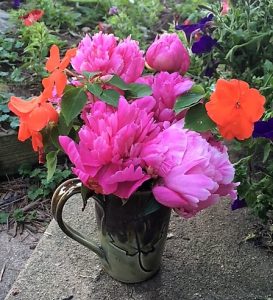 I’m tempted to add the creature comforts–starting my day with the perfect cup of tea–but those come after the soul food. We are seeing more and more of the people who have all the money in the world, but when I look at those guys, I wonder, “Are you even happy, Mr. ManyBucks? You don’t look, sound, or act happy to me, and no part of me wants to be you or have your money.”