






 An experienced foster mom once said to me, “I know the kids are going to be alright when I hear them laughing. Some of them have taken months to laugh, one poor little guy never did. But once they laugh–provided it’s a good, hearty, silly laugh–I can relax a little.”
I was reminded of her wisdom when my daughter was dealing with some awful adolescent turbulence. The medication was making things worse, she was growing more isolated in part out of a mutual decision to try home schooling. I was doing everything I knew to do–counseling, horse barn, psychiatrist–and nothing seemed to be turning the situation around (it did turn around, eventually). I was puttering along downstairs, and I heard her up in her room laughing. Haw-haw-haw, ridiculous laughing.
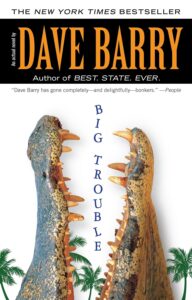
I had assigned her one of Dave Barry’s novels, probably Big Trouble, and she had succumbed to his comedic magic. To speak humorously is a gift, to write humorly is a superpower, and Mr. Barry had my depressed, troubled, “at risk” daughter in stitches. I wrote him the sappiest fan letter an author ever did write to anybody. He made my kid laugh for what might have been the first time in months.
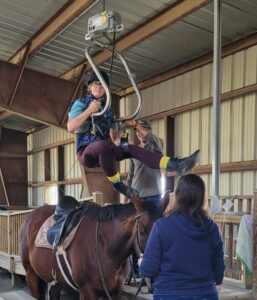 Yesterday at the therapeutic riding barn a couple of the other instructors and I were tasked with desensitizing one of the horses to a rider mounting and dismounting using a mechanical lift. I volunteered to be the “rider,” in part because I want to know what a student has to deal with when they use that device to get on or off a horse. I also wanted to be helpful, and–honestly–these days, I’ll take any excuse to sit on a horse.
The horse was an absolute, utter champ. He stood like an equine testament to eternity while I went up and down, over and around in the lift. Brushed him with my boots on the withers and croup, jabbered, swung my legs like an excited eight-year-old, and that horse did not flick an ear. The mental image of the chorus line from Robinhood: Men in Tights popped into my head, because the lift is on a track, and you can swing yourself to the left or swing to the right, step-behind-step-kick. step-behind-step-twirl…
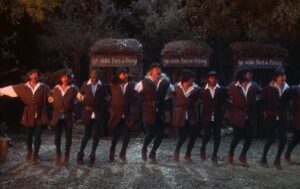 Which I did. Hilarity ensued, and the whole rest of the day, I heard the Men in Tights chorus in my head, and one of the other instructors referring to me as “Tinkerbell.” Even writing this, the memory makes me chortle.
Maybe this is the disarming absurdity of the Portland Frog, or it’s the kid in all of us taking charge for a few moments. I do not know what the secret sauce about laughter is, but I know when I can really and truly laugh, I’m a happier person. I have a little more courage, a little more self-appreciation, and I feel a little safer in my identity.
Who or what has recently tickled your funny bone? Do you have any memories of joyful laughter popping up when least expected? My family got the giggles on the way to my grandma’s funeral, and I know nobody would have approved more heartily of that loss of decorum than Grandma herself!
 Many therapeutic riding students are plagued by anxiety. Some of it is situational–horses can be unpredictable. They are big. They have enormous, sharp teeth. Their reflexes are much faster than a human’s. Many equines wear iron shoes. Whose idea was this anyway?
 abates. I suspect this is why most religious services start and end with music, and why sports events kick off with a musical moment–it’s a neurological hack that gets us feeling calm and at peace.
 of
of  after day. And this particular bottle of vitamins is guaranteed to work especially well for me, because it reminds me of the first time I was half-way competent at anything beyond tying my shoes or brushing my chops.
 My parents retired to the endless summer of San Diego, and my dad was happy there. Lovely breezes, tons of sunshine, that gorgeous (to him) ocean a block from the house. My mom adapted, eventually, but that was not her version of paradise, and when I had to spend summers there as a kid (or visit as an adult) I found it a nearly unbearable purgatory.
 But the other problem was… the SoCal climate disagreed with me. Nearly every day the same, with the big story on action news being June Gloom (fog that burns off by noon), or rarely, rain. Global warming has changed the climate in San Diego somewhat (and added wild fires to the calendar), but you still won’t find me moving there for a Highland Chocolatier gift certificate nor money.
 We have about twelve hours each of darkness and daylight now, and that seems to suit me. I wake up as it’s getting light, and I go through the day with more of a sense of, “No lollygagging. We’re burning daylight!” In summer, when it’s light until 9 pm, I’ll put off my walk until 8 pm. In winter… well, I rely on my days at the therapeutic riding barn to get the step count up in winter.
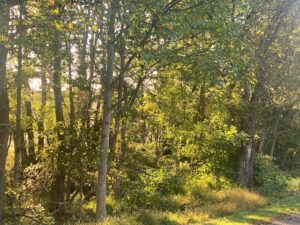 I regard fall as the sweetest season. Winter around the corner makes me treasure the beautiful light, the scrumptious weather, the last of the flowers, the open windows. If I ever do leave my bide-o-wee here in Maryland, I will have to move to someplace that has fall, however briefly, or I will go into a decline.
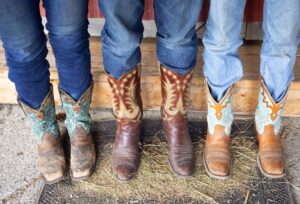 I have not shopped for blue jeans for about, oh, maybe… fifty years. Even now, when I’m at a healthy weight, my calves are so grand that finding pants to fit them often leaves every other aspect of the garment gapping and sagging. I’ve tried men’s jeans, mom jeans, baggy jeans… I just gave up on jeans and thanked heavens for yoga pants and their many near kin.
 Except I needed jeans a pair of jeans to wear on the night in question. I asked around, “Where do you buy jeans these days?” (Meaning, in my case, in this century.) Old Navy got a few nods so I checked out their DEI creds, and then had a look. I found a couple pairs of jeans that actually sorta, well, yes, fit. Golly days. That’s odd in itself.
 Hmmm. Guys in the fitting room area. I decided that this is a kinda big deal, because it declares clothes shopping to be a human activity rather than a gender-segregated activity, at least where jeans are concerned. It declares that as a shopper in that store, I am a person first rather than a gender first, and that I’m supposed to look at sales associates as sales associate people first rather than as a specific gender. I see value in this approach, potential equality, and no diminution in the quality of the shopping experience.
 I am not ready to buy a bra from a guy, but maybe I should be. When I asked where the ladies’ belts were or where to put back the baggy high rise pair that didn’t fit, the sales associate had the answers. When I gushed a little at the check out over being able to find a pair of jeans that mostly fit, the sales associate made the appropriate “Go, granny, go!” noises.
 My paternal grandmother was a widow with a baby at age nineteen, her husband having been a casualty of World War I. She married two more times, ditched both (drunken, philandering) husbands before divorce was popular, and at age sixty, opened up a candy store that would support her adequately until she died in her eightieth year. My maternal grandma welcomed her first born into the world in a tent at Joe Junior mining camp, and gave birth to her last-born at age 45.
 So I realize that deciding to attempt the therapeutic riding instructor certification was both an exercise in privilege (in many ways), and a pretty tame effort as challenges go. I have plenty of positive experiences with learning goals. I have been around horses for decades. I had great support going into the venture, and found more support along the way. A walk in the pasture–right?
 As I drove over the hills to take my final test, though, it occurred to me that getting the certification might not be the point. Because I aimed at that goal, I took my hearing loss more seriously. It’s hard to understand somebody who is speech-impaired when you have good hearing. Try it without the upper frequencies, and you’re at a disadvantage as an instructor.
 The first and primary beneficiary of my jaunt down the riding instructor path was me. I learned a lot of material that interests me, I am taking better care of myself, and I flexed my ability to ask for help (not one of my strengths). My goal was to qualify for a certification, but in hindsight, I think my goal should have been simply to challenge myself. Pass, fail, or try, try again, the challenge itself has done me a power of good.
 I made a couple changes this summer to how I occupy my house, and I’m only realizing now some of the undesirable consequences. The first change was to put a mama cat and her four wee teeny little kittens in the upstairs half of my house. Once they are all fixed and have finished all their shots (later this month), they will be transitioned to another, much less restrictive situation.
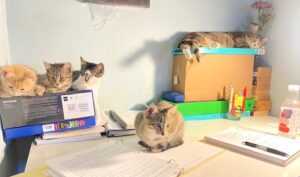 Initially, I was pleased with myself. I was being organized, keeping order in my house, and checking the “everything in its place” box. But as the summer wore on, I felt a sense of, “All I do is work.” Start off with upstairs cat chores, move to downstairs cat chores, shift to writing tasks, take a break/not really a break to get in steps, head upstairs for some studying, downstairs to deal with emails and payroll, toss in more cat chores, back upstairs for more studying at the end of the day… pick the three upstairs litter boxes before lights out.
 With the possible exception of the kitchen, I have work waiting for me in every part of my house. (My washer and dryer are in the bathroom, and I do a fair amount of pet-related laundry.)
 The situation will fix itself when I’m through my riding instructor curriculum, and the five foster cats go to their next billet, but I hadn’t realized how much I benefit psychologically from having a specific consistent place that is work-free. I hadn’t realized how good it feels to close the door at the bottom of the steps, and climb up to the place where I am not a writer or a student or a cat mom, but just me, who likes to read, who needs to rest, who wants to recharge before jumping back into the affray in the morning.
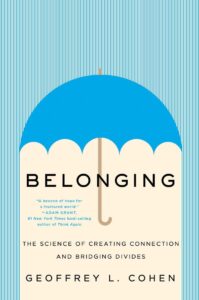
 My summer reading list this year includes titles such as,
  Whether we crossed the river above or below the tree last year truly did not matter anywhere near as much as staying on good terms with the women who made the rafts. Be willing to let the truth slide–we did cross above, despite what Og says–and you won’t be left to entertain the lions on the wrong shore.
 And because I am the queen of my writing desk, Julian’s willingness to stand alone in the hope of discovering the truth always results in freedom for a formerly oppressed party and some self-affirmation for Julian. Neener-neener!
 I’ve spent much of July and August studying for the final therapeutic riding instructor test I plan to take in September, but this summer has also focused me on some other kinds of learning.
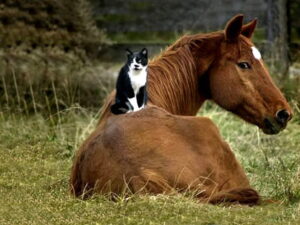 Because I wanted to study the riding curriculum, and because even I knew I needed a break, I stepped back from my therapeutic riding barn in Virginia. I’ve kept a hand in with a smaller, slower-paced barn here in Maryland, and the contrast has been edifying. The lesson for me is that being equal to a challenge and deriving benefit from that challenge are two different propositions. I could have spent the summer with the Virginia crew, on a tighter schedule, with a larger staff, and a larger client rotation (also some larger egos), but for where I am on all sorts of learning curves, the more modest operation has been a huge, unexpected exhale.
 This summer has also presented me with opportunities to work on my listening skills, for want of a better term. Because I’m not spending hours on end at a barn, I’m getting in steps by walking my own neighborhood more than I ever have. In the past eight weeks, I have talked to more, different neighbors than I did in the previous eight years. One woman told me that our daughters went to school together–thirty years ago–and we have lived about a mile apart for those whole thirty years, but never spoken previously. She was an absolute delight and gave me some mimosa tree seeds (butterflies love mimosas).
 For the first time in a long time, I nearly raised my voice at someone this week. Current events are enough to shorten anybody’s fuse, but on this occasion, the irritant that nearly started the bonfire was Amazon customer service.
 I rolled up my sleeves and started with author support. “Could somebody please help me find my books?” Author support laughed politely. “It’s a log in issue, and for that you have to deal with Amazon customer service.” Round and round I go, unable to make anybody understand that I can log in, but my books are gone. Finally, I get some lady in an overseas call center, who also did not grasp the issue.
 I might be a little less crispy about 100 books–my livelihood, that I cannot replace–going poof, were it not the case that Amazon is making record profits by the billions, yet again, some more, how wonderful. I might be even less crispy about it if I hadn’t gone through multiple iterations of, “Call back is not working at this time,” and “The chat bot is not working at the time.”
 It’s a good thing she was on the other side of the planet. Telling me what to feel and what not feel when I am legit upset, and wasting my time while lying to me. That there’s a class one, ten years to life, no parole collection of felonies in my book…. or it would be, if I’d written any books.
 A couple of ideas collided for me this week, one stemming from Heather Cox Richardson’s
 Then I read
  This juxtaposition of ideas, that our hobbies and enthusiasms help define us, and that knowing and acting on who we are makes for a healthy society was reassuring to me. I can water my zinnias, I can remind the nice people at the pharmacy that all this wildlife only showed in our end of the valley when that huge housing development went in a few miles to the north.